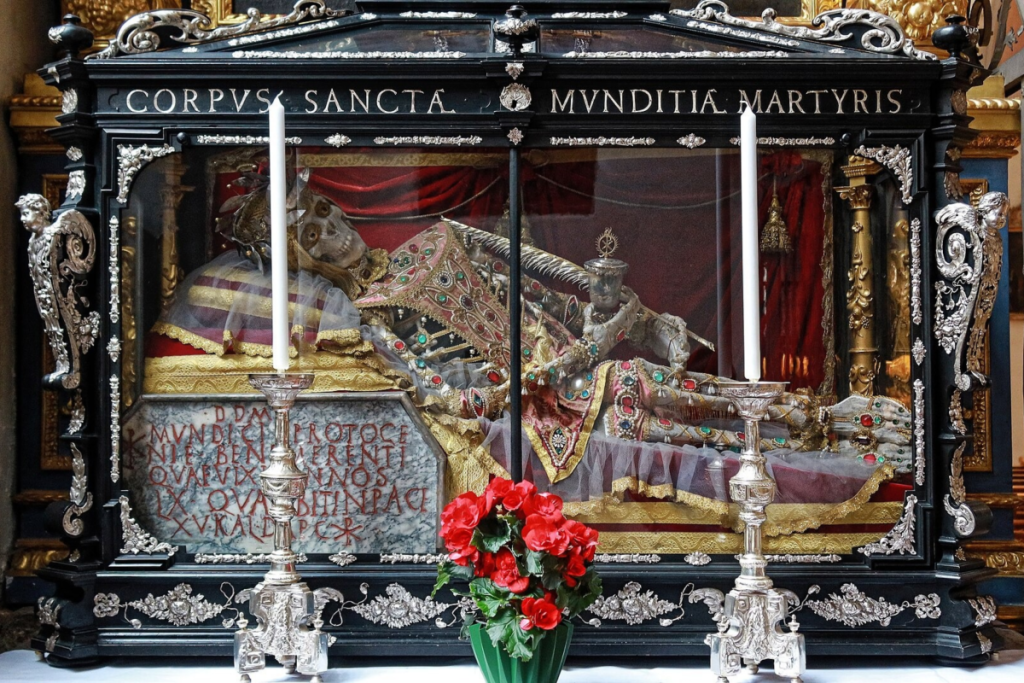

She is a bit eerie, lying there like that and staring at you with her wide-open eyes. While most visitors trudge up to the Old Peter, others prefer to pay a visit to Saint Munditia, who is on display here in the church. Her richly decorated skeleton exerts an indescribable fascination and attracts more than just the faithful. But who was this woman, and how did she end up in Munich?
The Unknown Martyr

The relic of Munditia Protogenia actually comes from Italy, where it lay until 1675 in a niche tomb at the Roman church of San Lorenzo. She was one of the catacomb saints whose remains were removed from Rome beginning in the 16th century. In 1675, councilman and merchant Franz Benedikt Höger received the relic of Munditia as a gift for St. Peter’s Church in Munich, where he brought it two years later. Very little is known about the saint. She was likely born around 250 and died a martyr in 310. The marble slab of her niche tomb in Rome bears, among other things, the letter combination APC, which could stand for Ascia Plexa Capita, meaning “beheaded with an axe.” The slab is also located at St. Peter’s today.
She is considered the patron saint of single women and was venerated as such in Munich as well. The women working at the brothel at Sendlinger Tor would visit the relic in its glass coffin. This is because Munditia is said to support single women in their daily lives or help them find love. However, the cult surrounding the saint suffered a setback in 1804 when the Munich city councilors banned the public display of relics. Until 1883, a wooden shrine concealed the skeleton; since then, it has once again been on display behind glass. To this day, a candlelight procession in her honor is held at St. Peter’s Church on November 17, the feast day of Munditia. Afterward, the pastor blesses the participants upon request by placing the relic on their foreheads.
The Magnificent Munditia
Today, you’ll find Munditia in the left aisle of St. Peter’s Church, where she rests on cushions in a glass coffin. She wears a veil on her head and a sash around her body, studded with colorful glass stones . In her left hand she holds a feather; in her right, a chalice containing the blood she lost during her execution. In 1975 , the rich embellishments prompted a thief to remove the relic from the casket, steal the stones, and impale her head on a grille. He must have mistaken the worthless glass stones for gemstones.
Munditia’s head is now back on her body, staring intently at her visitors. Her skull contains glass eyes that make it seem as though the skeleton is looking right at you. These eyes are the reason why some people find the relic creepy. Still others make a point of visiting her, just as they would visit Ludwig II in the Wittelsbach Crypt. If you’re a single woman looking for true love, you should stop by and see Munditia. Maybe you’ll find happiness soon.