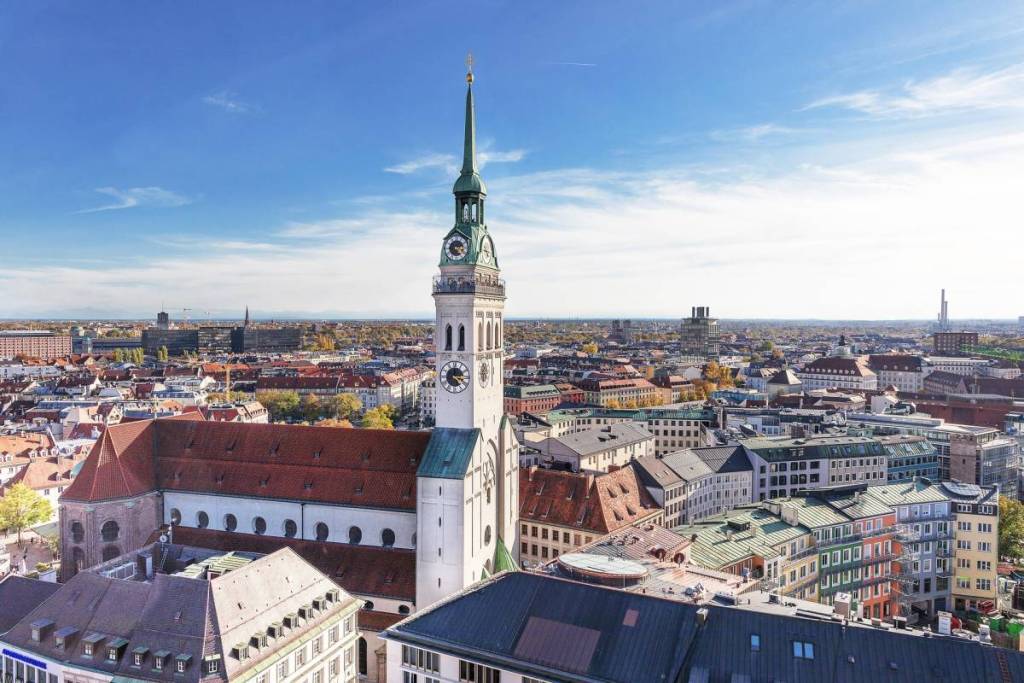

When you think of famous churches in Munich, the Frauenkirche and the Theatinerkirche probably come to mind first. St. Peter’s, on the other hand, tends to fly under the radar for most tourists—even though the church features prominently in photos of the city. Locals primarily associate the church with its tower: the “Alter Peter.” It’s not only a great vantage point but also the subject of some curious stories that some of you probably haven’t heard yet.
The Other Devil’s Footprint
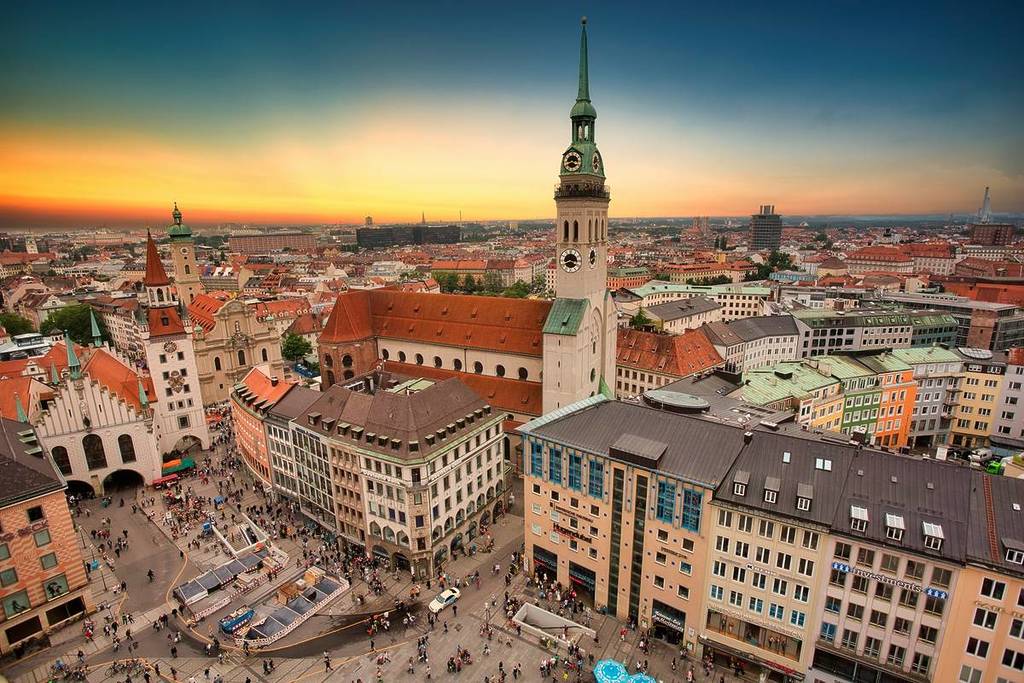
St. Peter was first mentioned in 1225 and is thus considered the city’s oldest parish church. It is located on Petersbergl in the center of the triangle formed by Marienplatz, Viktualienmarkt, and Rindermarkt. Originally, a Romanesque building stood here, which was later replaced by a Gothic one . Over time, this building underwent further renovations, and after St. Peter suffered extensive damage during World War II, a comprehensive reconstruction followed, which also included the ceiling frescoes.
The church used to have two towers, but after a fire, it was decided to combine them into one. Today, you can still see where the old towers were cut off at an angle and joined together in the middle. The locals call this tower “Old Peter.” Where the observation deck is located today used to be the watchman’s tower room. From up here, the watchman kept an eye on the city and sounded the alarm in case of fires. To do so, he rang the bells—of which there are still eight today, four of them historic. But the Old Peter has not only eight bells, but also eight clock faces. Karl Valentin once joked that the reason for this was so that eight people could read the time at once. In fact, the clock in the Old Peter is considered Munich’s oldest city clock.
Perched atop the tower’s roof is the tower cross, which, over time, tilted 90° toward the nave. According to legend, the devil stomped the cross down in a fit of rage—so it’s not just the Frauenkirche that has a “Devil’s Footprint.” In reality, the wind was to blame for the tilt, which is why it was repositioned perpendicular to the wind direction during the tower’s renovation in 1876. To celebrate the completion of the renovation, a topping-out ceremony was held, during which Lorenz Wach, a tinsmith’s apprentice from the “Alter Peter,” proposed a toast and then threw his empty glass down from the tower. The glass remained intact and is still part of St. Peter’s treasury today.
View from the “Alter Peter”
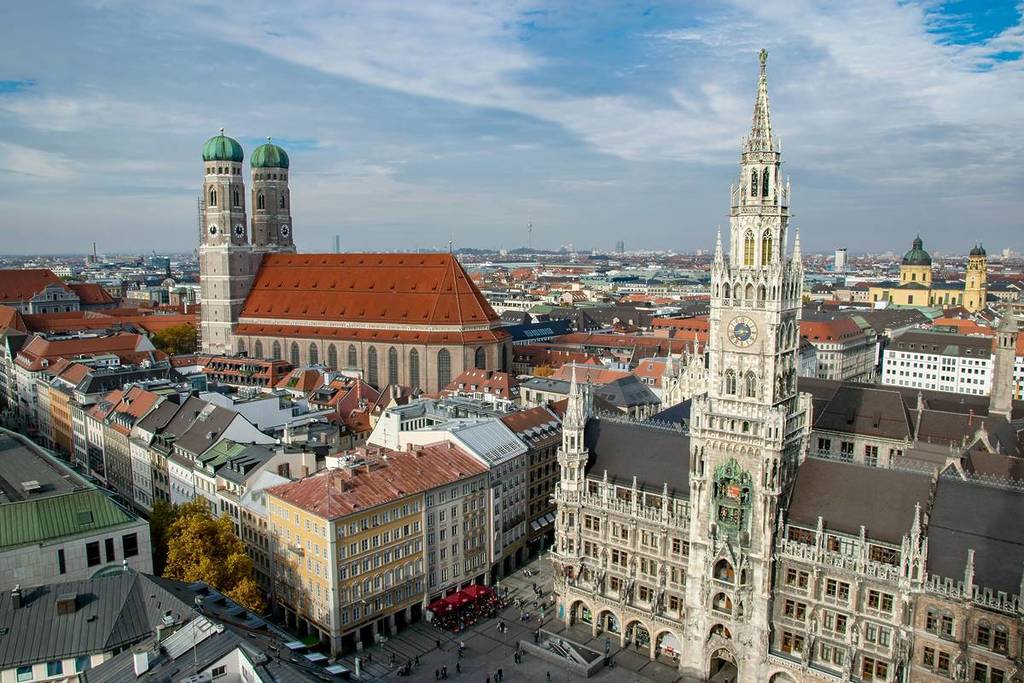
You’ll have to work for the view from the “Alter Peter.” The tower measures 91 meters to the top, and the observation deck is located at 56 meters. To reach it, you’ll need to climb 306 steps— there’s no elevator. Once you’ve made it to the top, you’ll be rewarded with a magnificent view. You can walk all the way around the tower, so you can truly see in every direction. When the Föhn wind is blowing, visibility extends up to 100 kilometers, allowing you to spot the Alps on the horizon. Beyond that, of course, the city’s landmarks rise up before you: the New City Hall, the Frauenkirche, the Olympic Tower, and the Theatinerkirche. You’ll also be able to see the Old City Hall, the Heilig-Geist-Kirche, and St. Maximilian from up here.
After you’ve thoroughly enjoyed the view from the top and then made your way back down, you should also take a look inside the church itself. The magnificent ceiling frescoes and the stucco work on the walls are a sight to behold. The Gothic sandstone altar is the only one of its kind in the city, featuring a golden statue of St. Peter wearing a tiara at its center. When you leave St. Peter’s, you should take a closer look at the outer wall once more. On the outer choir wall, you’ll discover a cannonball embedded in the wall. It was fired at the church from the Gasteig during the Coalition Wars and shattered a window there. Later, it was embedded in the wall as a memorial.
📍 Location: Petersplatz 1
🕐 Hours: Daily from 9:00 a.m. to 7:30 p.m. (April through October) or 6:30 p.m. (November through March)
💶 Price information: €5 regular, €3 reduced