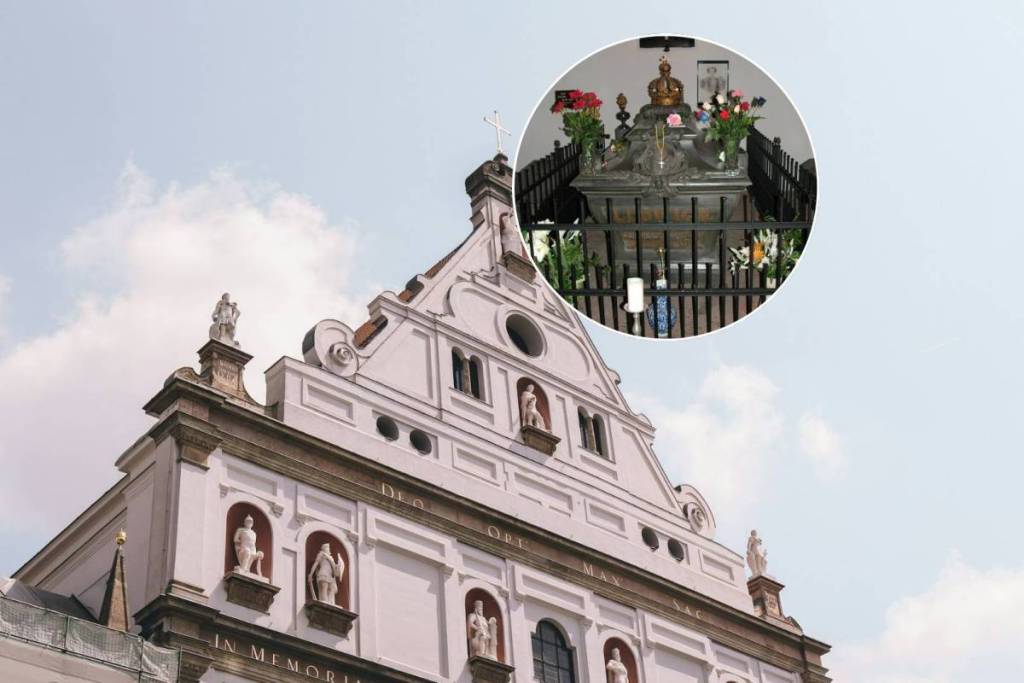

In downtown Munich, several sacred buildings rise up, significantly shaping the cityscape. Some of them house royal burial sites, with the crypts beneath the Theatinerkirche and the Frauenkirche likely being the best known. But there is a third burial site that is no less historically significant —quite the contrary, in fact. In the Wittelsbach crypt at St. Michael’s on Neuhauser Straße, quite a few nobles found their final resting place, including none other than Ludwig II.
The Princely Burial Chapel

St. Michael’s Church was built starting in 1583 as the first Renaissance structure north of the Alps. On the one hand, it was intended to serve as a place of worship for the college that was being built at the same time; on the other hand, it was designated from the outset as a burial site for the Wittelsbach family . Thus, beneath the impressive interior lies a princely crypt that is one of the most significant resting places of the Wittelsbach family. Thirty people are buried in the crypt and ten more in the columbaria, though the latter are not open to visitors.
Among the Wittelsbachs buried here are several famous family members, such as King Maximilian I and King Otto I. The most famous, however, is undoubtedly Ludwig II, whose tomb you can also see here. He died under mysterious circumstances in Lake Starnberg, and to this day it remains unclear whether he entered the water of his own accord or was murdered. The secret society known as the Guglmänner was certain that it must have been a crime, which is why they demanded that the sarcophagus in the Wittelsbach crypt at St. Michael’s be opened. The fact that this request was consistently refused only strengthened the Guglmänner’s suspicion that Ludwig’s remains were not in the tomb.
A Visit to the Wittelsbach Crypt at St. Michael’s
Whether Ludwig is actually buried in the princely crypt or not, we’ll probably never know. However, you can examine his magnificent coffin up close here . You’ll recognize it immediately by the crown emblazoned on its lid and the railing that surrounds it—features absent from the other coffins. Furthermore, there are always fresh flowers or wreaths at his feet. The other tombs are also worth a look, as they all differ in their design and inscriptions.
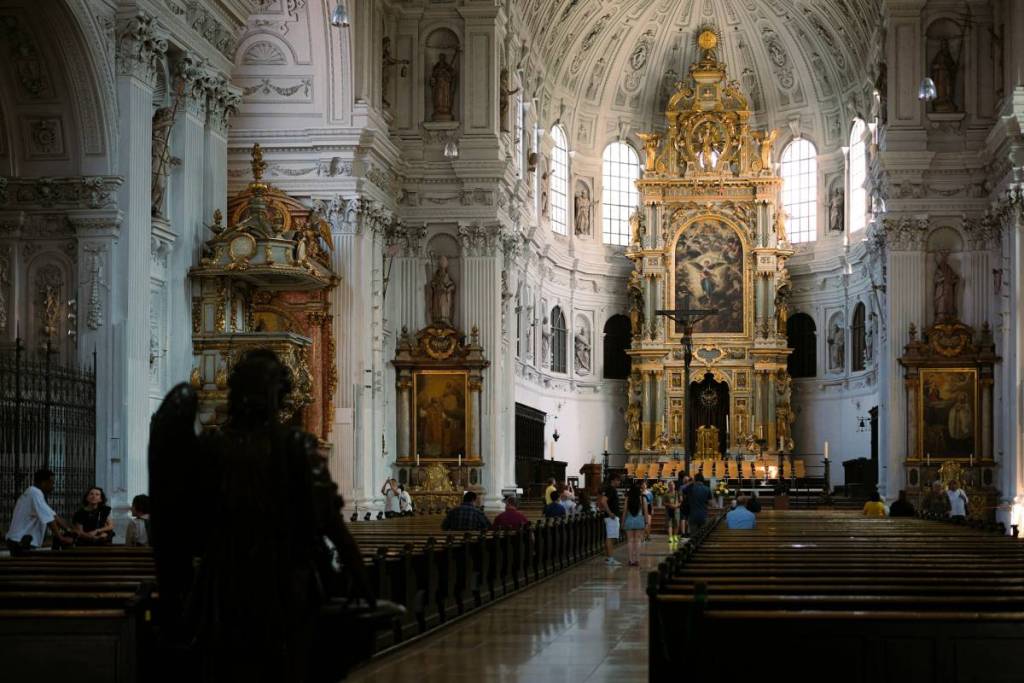
If you’re interested in history, then a visit to the Wittelsbach Crypt at St. Michael’s is definitely the right choice for you. To reach the crypt, you’ll need to walk all the way through the nave. Take this opportunity to admire the impressive architecture and decorations of the church itself. It’s also worth taking a second look from the outside, as St. Michael’s façade is adorned with numerous statues. At the bottom, between the portals, you’ll be greeted by the Archangel Michael, after whom the church is named. Admission to the church is free, while entry to the crypt costs €3. However, you can visit it for free on All Saints’ Day.
📍 Location: St. Michael, Neuhauser Str. 6
🕐 Hours: Mon–Fri 10 a.m. to 12:30 p.m. & 1 p.m. to 5:30 p.m., Sat 10 a.m. to 12:30 p.m. & 1 p.m. to 4:30 p.m.
💶 Admission information: €3 regular, €2 reduced, €1 for teens