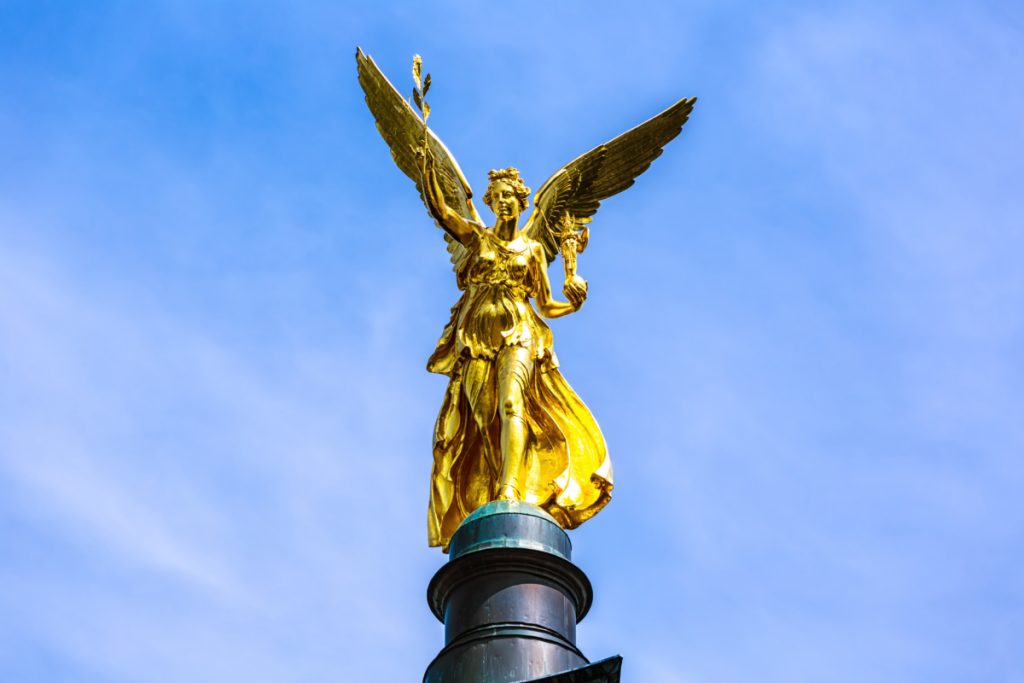

Those who want to enjoy the sunset in Munich usually choose between the Hackerbrücke, the Olympiaberg, and the Friedensengel. The latter is one of the many places in the city that bring a touch of ancient Greece to the city. Here, you can sit on an impressive terrace and, as you look west down Luitpoldstraße, you’ll see not only the Angel (who isn’t an angel at all) but also a temple rich in detail behind you. Find out what the Angel of Peace really is and why he almost learned to fly.
A goddess of victory as a symbol of peace
The entire complex surrounding the Angel of Peace is actually called the Peace Monument and is dedicated to the end of the Franco-Prussian War. The city of Munich donated it to the House of Wittelsbach on the 25th anniversary of the Peace of Frankfurt. The cornerstone was laid on May 10, 1986; three years later, the monument was completed and unveiled. It measures a total of 38 meters and depicts the Greek goddess of victory, Nike, holding an olive branch. She is perched atop a 23-meter-high Corinthian column, which in turn rises from a 9-meter-high temple.
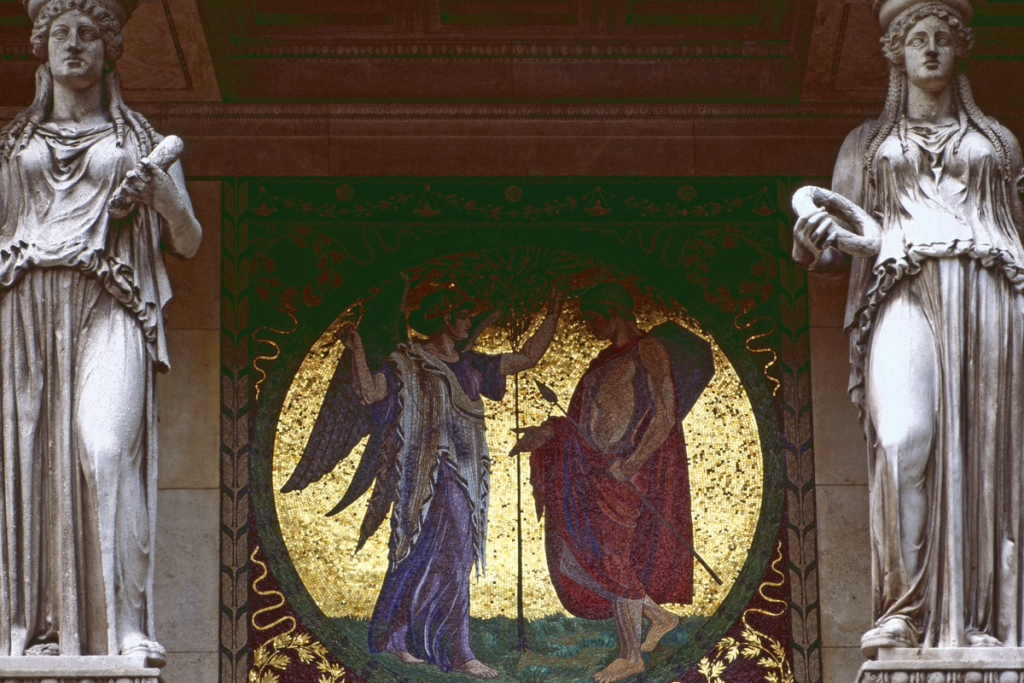
The temple’s roof is supported by eight female sculptures and four corner pillars, which depict the heroic deeds of Hercules on 12 medallions. Twelve additional medallions feature Bavarian and Prussian figures, such as Wilhelm I, Ludwig II, and Prince Regent Luitpold. Inside the temple, you’ll find four mosaics depicting war, victory, peace, and prosperity. On the roof itself, you’ll discover four finials reminiscent of ancient trophies. Rising above the temple is the column featuring a gilded statue of Nike. Her wings have a wingspan of five meters, earning her the nickname “Angel of Peace.”
When the Angel of Peace Threatened to Fall
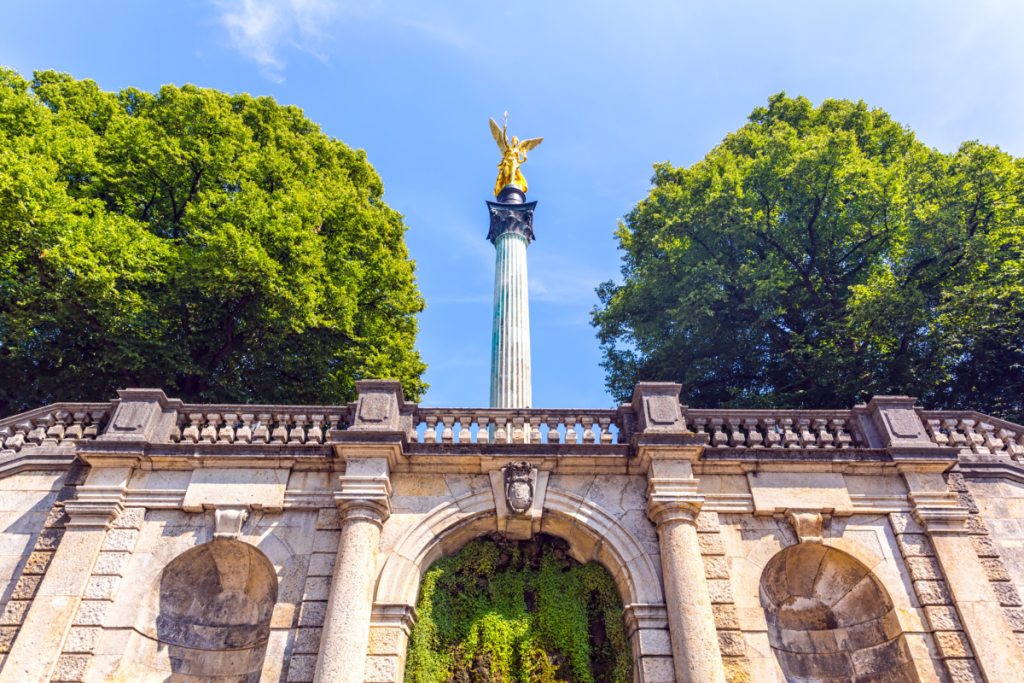
During World War II, the Angel of Peace was covered up and thus survived the war unscathed. Nevertheless, due to material fatigue, there was a serious risk of it falling after several decades. In 1981, the sculpture was dismantled, given new wings and a new supporting base, and placed back on the column two years later. For the monument’s centennial in 1999, the Nike was given a new gold plating. Since then, she has once again been shining over the Luitpold Terrace and the fountain complex.
Today, the Angel of Peace is not only a well-known tourist attraction but, thanks to the terrace there, also a popular viewpoint among locals . Your visit can be perfectly combined with a stroll through the Maximiliansanlagen, from the center of which the sculpture stands out. Below the Angel is an underpass that conceals a street art gallery. Here you’ll discover large-scale works of art on the walls and can reach the terrace directly via a staircase.