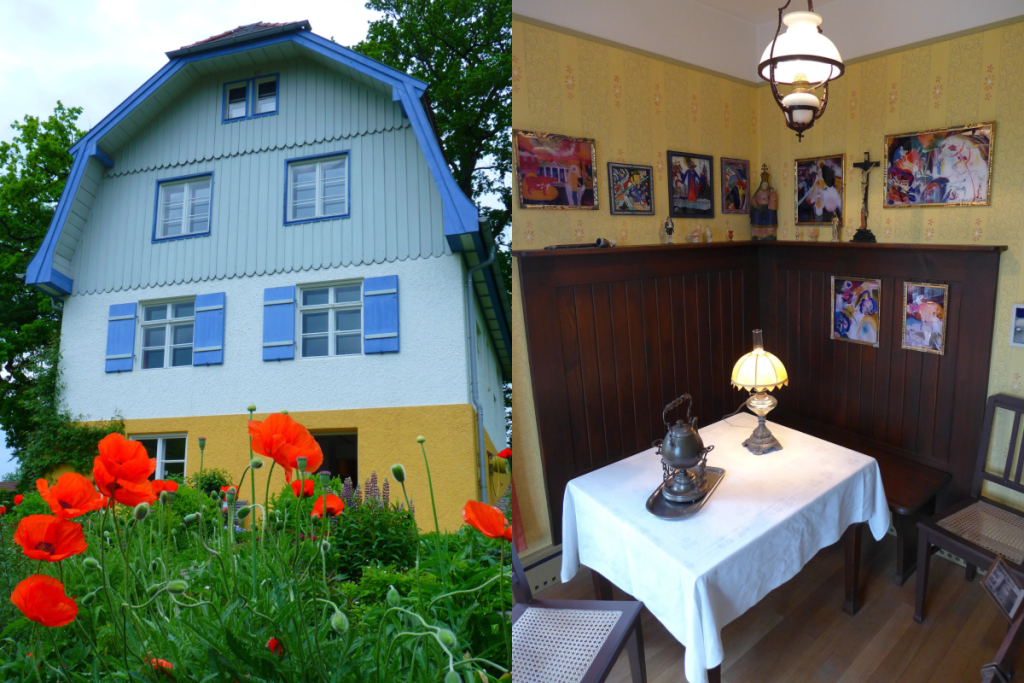

For anyone interested in the artworks of the group associated with the almanac “Der Blaue Reiter,” the Lenbachhaus in Munich is the first place to visit. If, on the other hand, you want to get to the bottom of the inspiration behind the paintings, you’ll have to leave the city. In the so-called “Blue Land,” Gabriele Münter, Wassily Kandinsky, and their friends found the inspiration for their Expressionist work. At the Münter House in Murnau am Staffelsee, you’ll discover how the couple lived and where they created their art.
The artists’ home
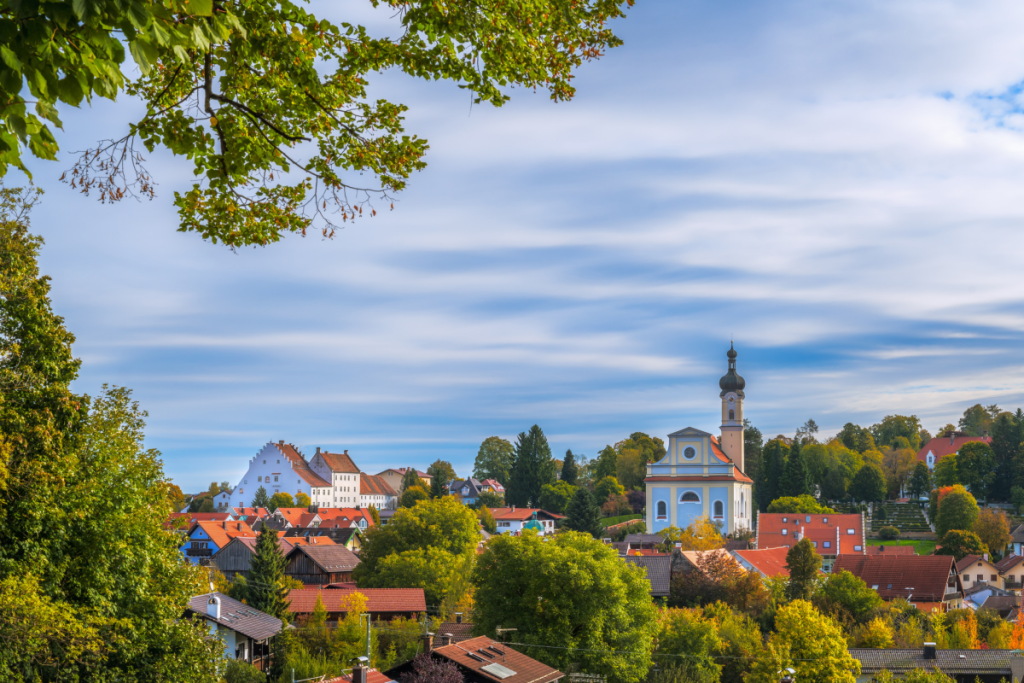
Gabriele Münter and Wassily Kandinsky met in Kallmünz in 1903. The market town in the Upper Palatinate was a popular destination for artists at the time and inspired Kandinsky to turn to abstraction. The two became a couple and moved to Murnau am Staffelsee in 1909, where Münter purchased the house at Kottmüllerallee 6, across from the railroad tracks. They often had their artist friends over, such as Franz Marc and Paul Klee, who were also members of the Blue Rider group. In Murnau, they developed their Expressionist style and drew inspiration from the local tradition of reverse-glass painting.
Since Wassily Kandinsky was Russian, the locals nicknamed the building the “Russenhaus” (Russian House). Today, however, it is known as the “Münter House.” The couple lived here until the outbreak of World War I in 1914, when they fled to Switzerland. Kandinsky eventually returned to Moscow, while Münter initially stayed in Northern Europe. In the late 1920s, she finally returned to the Münter House in Murnau and lived there until her death in 1962.
A visit to the Münter House
During World War II, Gabriele Münter hid Kandinsky’s works in her basement to save them from the Nazis. On her 80th birthday, she bequeathed them to the city of Munich, which exhibits the paintings at the Lenbachhaus. But you can also view some of the paintings right here at the Münter House. After the artist’s death, her house was turned into a memorial and a museum to honor her art as well as that of her former partner.
In 1998 and 1999, the house underwent extensive restoration and was returned to its original 1909 condition. During your visit, you’ll be transported back to the time when the couple lived here and gain insight into their daily lives. At the Münter House, you’ll discover not only the couple’s paintings but also the furniture they painted themselves. The exhibition also features several watercolors and prints. The museum is open for three hours every day except Mondays, and admission costs just €4.
🕑 Hours: Tue–Sun 2:00–5:00 p.m.
💶 Pricing information: €4 regular, €40 for special openings