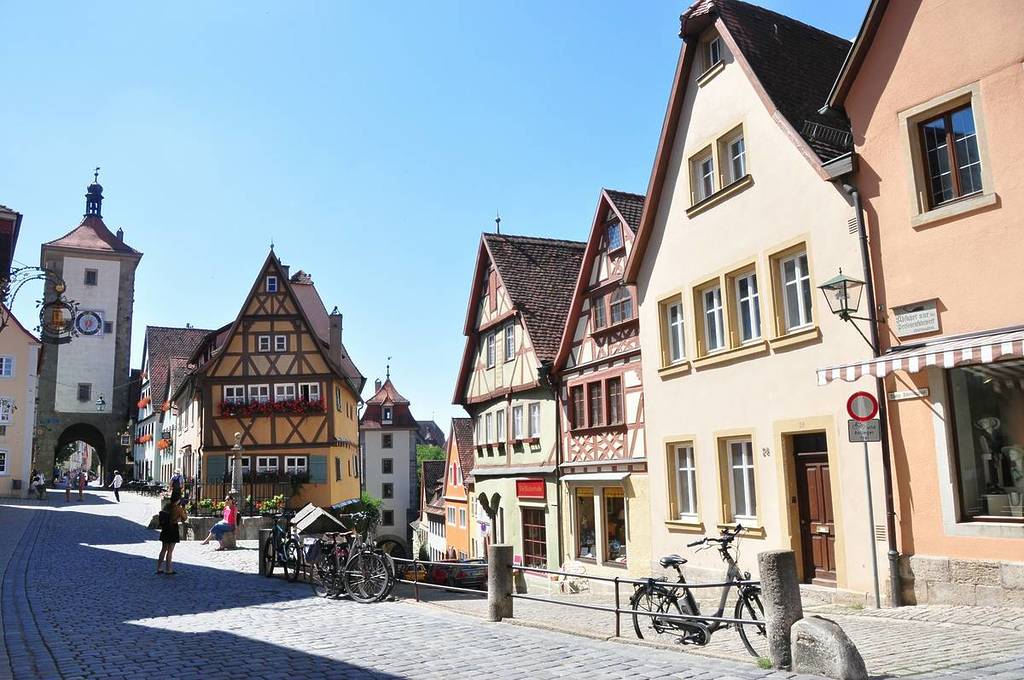
Three hours from Munich lies this small medieval town, which was granted its town charter in the 11th century. With over 5,000 inhabitants, it was one of the largest towns in the Holy Roman Empire. Today, it is not only known for its beautiful half-timbered houses, but also for the fact that Christmas is celebrated here all year round. Immerse yourself in a fairytale world steeped in history.
Journey into the Middle Ages

You walk through narrow alleyways, over cobblestones and past old walls on your stroll through the city. It almost feels like a little trip back in time, were it not for the evidence of the 21st century to be spotted here and there. The town got its name from the castle around which a settlement was built. In 1172, Emperor Frederick I Barbarossa granted it town privileges, which led to the construction of the town wall. This wall is characterized by its 42 towers and six gates, for which the city is also known as the “Franconian Jerusalem”.
100 years later, in May 1274, King Rudolf of Habsburg elevated the town to a Free Imperial City. However, it was not only politically important at the time, but also economically and religiously. It became an important trading town whose merchants were active in Italy and the Czech Republic, among other places. It became a place of pilgrimage for the faithful , who paid a visit to the relic of the Holy Blood. Due to the boom, new buildings were erected in the town, such as St. Jacob’s Church and the basilica.
After the end of the Thirty Years’ War , the town increasingly lost its importance and influence, although it continued to play a role both economically and spiritually. Although the town fell victim to war attacks in 1945, almost 600 buildings remained intact and the remaining buildings were rebuilt true to the original.
The Christmas capital of Germany
https://www.youtube.com/watch?v=smheVzQVuy8
Christmas plays a very special role in Rothenburg ob der Tauber. On the one hand, of course, there is the annual Reiterlesmarkt, which accompanies the town through Advent from the end of November to December 23. 61 stalls await visitors to the Christmas market, there is also a stage for brass band music and an Advent window opens every day at the town hall. In addition, the old town is festively decorated and shines in sparkling Christmas lights.
Rothenburg is also home to the famous German Christmas Museum. On display here are Christmas decorations from the period 1870 to 1950 as well as other objects that bear witness to the traditions of the festival. Here you can learn more about the development of Christmas traditions and the significance of the festivities.
And last but not least is the Käthe Wohlfahrt Christmas village. Instead of just during the Advent season, you can store for Christmas accessories here all year round. Over 12,000 items are waiting to be discovered.
Visit to Rothenburg ob der Tauber

Rothenburg ob der Tauber is a popular excursion destination and is now heavily influenced by tourism. The beautiful old town makes the town world-famous and was even voted the most beautiful old town in Germany in 2021. If you visit Rothenburg, be sure to walk the town wall. Make sure you allow enough time for this, as the entire tour takes a good two and a half hours. The starting point is the Röderturm tower, which offers you a great view. But you shouldn’t skip the town hall tower either if you don’t want to miss out on a breathtaking view.
The eponymous Rothenburg no longer exists; where it once stood is now the castle garden. From here you can enjoy the wonderful view over the Tauber Valley and the beautiful planting in the park invites you to linger.
In addition to the Christmas Museum, the Crime Museum is also worth a visit. Here you can learn more about the development of German law, the persecution of witches and medieval torture. Spectacular criminal cases are retold and persistent legal myths are dispelled.
Those of you with a sweet tooth should not miss the famous Rothenburg snowballs. This traditional shortcrust pastry is typical of Rothenburg and makes the perfect souvenir. Their shape and the powdered sugar with which they are dusted give the snowballs their name.
You can reach Rothenburg ob der Tauber from Munich in two and a half hours by train or in just under three hours by car. It is therefore better to plan your trip with an overnight stay. Or stay in Nuremberg for a few days and make a detour to Rothenburg from here, as it is only 50 minutes by train.