When you think of statues you can walk through, the Statue of Liberty probably comes to mind right away. But you don’t have to fly across the pond to enjoy one— we have our own version right here in Munich. It towers nearly 20 meters above the Theresienwiese on its pedestal, and once Oktoberfest kicks off, we’ll be walking past it countless times again. Oktoberfest is the perfect time to explore the inside of the Bavaria statue.
Based on an ancient model
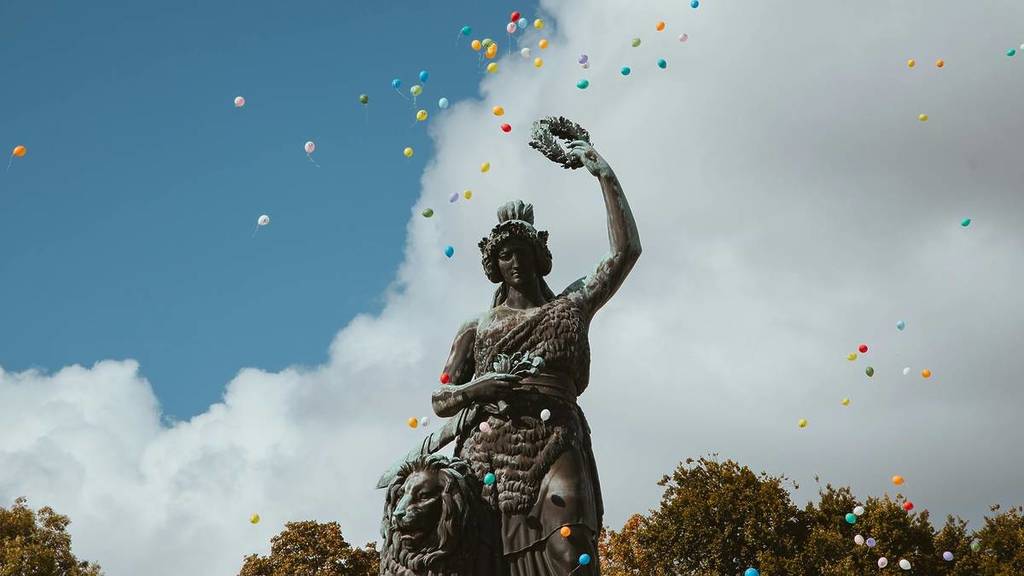
King Ludwig I made it his goal to forge a Bavarian identity. For this reason, he carried out projects such as the Ruhemshalle above Kelheim and the Walhalla near Regensburg. Their temple-like architecture reflects his fondness for ancient Greece. Because of this preference, he wanted to turn Munich into an “Athens on the Isar.” We can still see the results of these efforts today at Königsplatz and also at the Theresienwiese. Here stands the Bavaria statue, framed by the Ruhemshalle, as a patriotic symbol— a figure designed by Leo von Klenze as a Greek Amazon. The sculptor Ludwig Schwanthaler, who was entrusted with its creation, subsequently gave her a more Germanic appearance.
The Bavaria statue was the first colossal statue since antiquity to be cast entirely in bronze. It measures 18.52 meters and stands on an 8.92-meter-high pedestal, reaching a total height of nearly 28 meters. She wears an oak wreath on her head and holds another in her outstretched left hand. According to Klenze’s designs, she was originally supposed to hold a laurel wreath, but Schwanthaler changed it to an oak wreath, as oak is considered German. The bearskin she wears is also his idea and gives her a Germanic appearance. In her right hand she holds a sword, and a lion crouches beneath it. The lion is, on the one hand, the heraldic animal of Bavaria and, on the other hand, symbolizes military strength—as does Bavaria’s sword.
The view from the Bavaria statue

Ludwig had a new foundry built specifically for casting the Bavaria statue, where work on the statue began in 1844. Bronze from Turkish cannons was used to cast the statue’s four parts. In 1850, it was finally unveiled and dedicated during the Oktoberfest—even though Ludwig I had already abdicated by that time. Since then, the patroness of Bavaria has stood atop the Theresienhöhe, with the Hall of Fame behind her. The Hall of Fame displays busts of important German figures and, with its Doric columns, is reminiscent of a Greek Acropolis.
The interior of the Bavaria statue is hollow, so you can walk inside it. The entrance is located at the back of the pedestal, where the ticket booth awaits you. It costs €5 to climb up into the statue’s head. A narrow spiral staircase takes you up 126 steps, allowing you to admire the bronze casting from the inside. Once you reach the top, you can look down through the peepholes onto the Theresienwiese. A visit is especially worthwhile during Oktoberfest to watch the colorful hustle and bustle on the grounds from above. By the way, you can’t stand upright inside the head, but there are a few places to sit.
After your descent, you can stroll along the Hall of Fame at the bottom or take a detour to Bavaria Park, which lies behind the statue. Here you’ll find a lovely beer garden where you can stop for a drink and a great playground for your children. The grand staircase in front of the Bavaria statue is also a popular meeting spot to wind down the day with a view of the Theresienwiese. In winter, unfortunately, you can no longer tour the interior of the statue, but the slope down to the Theresienwiese is perfect for sledding. The Bavaria statue will remain open until October 20 before closing for the winter.
📍 Location: Theresienhöhe 16
🕐 Hours: Daily from 9 a.m. to 6 p.m. through October 19
💶 Price information: €5 regular, €4 reduced