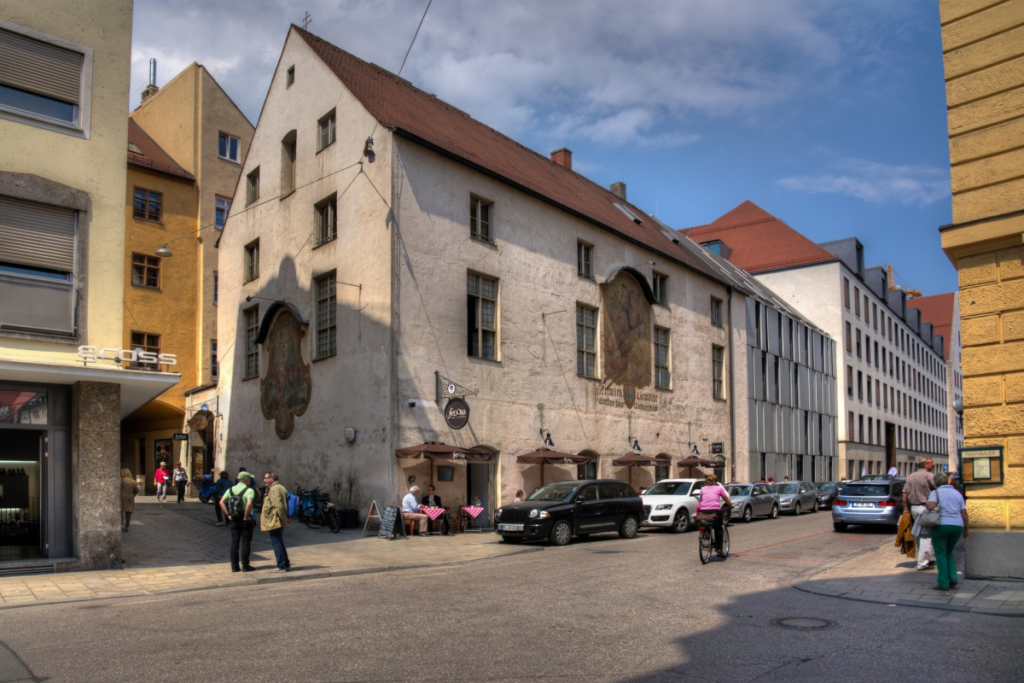

Amid all the pretty, colorful facades of the surrounding historic buildings, the gray Zerwirkgewöble stands out immediately with its simple architecture. You can tell at first glance that this building tells a long story, as cracks are visible in the masonry and dark frescoes adorn the walls. In fact, it is considered the second-oldest surviving building in the city after the Alter Hof and, as such, is a protected historic landmark. But currently, the historic building is leading a rather sad existence, caught between necessary renovation and a planned sale.
One Building, Many Functions
It is not possible to determine exactly when the Zerwirkgewölbe was built. One of the frescoes refers to the year 1264, though this cannot be verified. However, it is generally assumed that the building was constructed during the reign of Louis the Stern, who ruled between 1255 and 1294. Thus, the building likely dates from the late 13th century, making it the second-oldest in the city. It is located on Ledererstraße at the passageway to the Alter Hof, to which it originally belonged. In the 16th century, it was again part of the ducal Falkenhaus, after which court architect Matthias Schlichtinger acquired the building.
From 1733 onward, it served as an annex to the Hofbräuhaus, located very nearby on the Platzl. Hofbräu called the building the Herzog-Ludwigs-Haus; it did not receive its current name until 1808, when it served as the Hofzerwirkgewölbe. Hunters use the term “zerwirken” to refer to the butchering and preparation of game for later culinary use. It retained its function as a game-processing vault well into the 20th century. It was during this period that the lettering above the entrance and the two frescoes were created; these allude to the building’s former use and depict hunting scenes featuring game.
The modern Zerwirkgewölbe
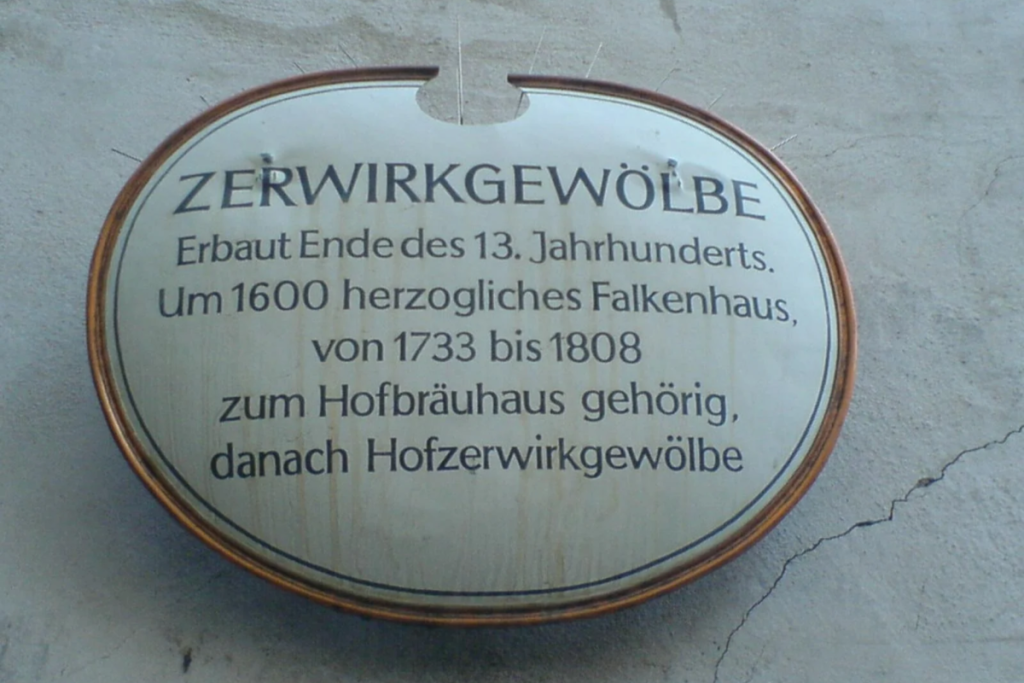
In the latter part of the 20th century, the Zerwirkgewölbe took on new functions, even though the name remained the same. It initially served as a studio theater before undergoing a major renovation in 2005. The interior spaces were designed to contrast with the historic exterior and were converted into a club, an event hall, and a restaurant. The large, distinctive vault in the basement was preserved. Until 2019, the Zerwirkgewölbe hosted a variety of dining options; since then, the building has stood vacant.
What the future holds for it remains unclear. The building is actually in urgent need of renovation: cracks run through the facade, which passersby sometimes cover with patches of pavement just for fun. Instead, the Free State has been trying to sell the building for years, with little success so far. The idea of a mini-Hofbräuhaus was also floated at one point, but it was eventually rejected. It remains to be seen what will happen to the Zerwirkgewölbe in the future and whether you’ll be able to view the historic building from the inside again.