
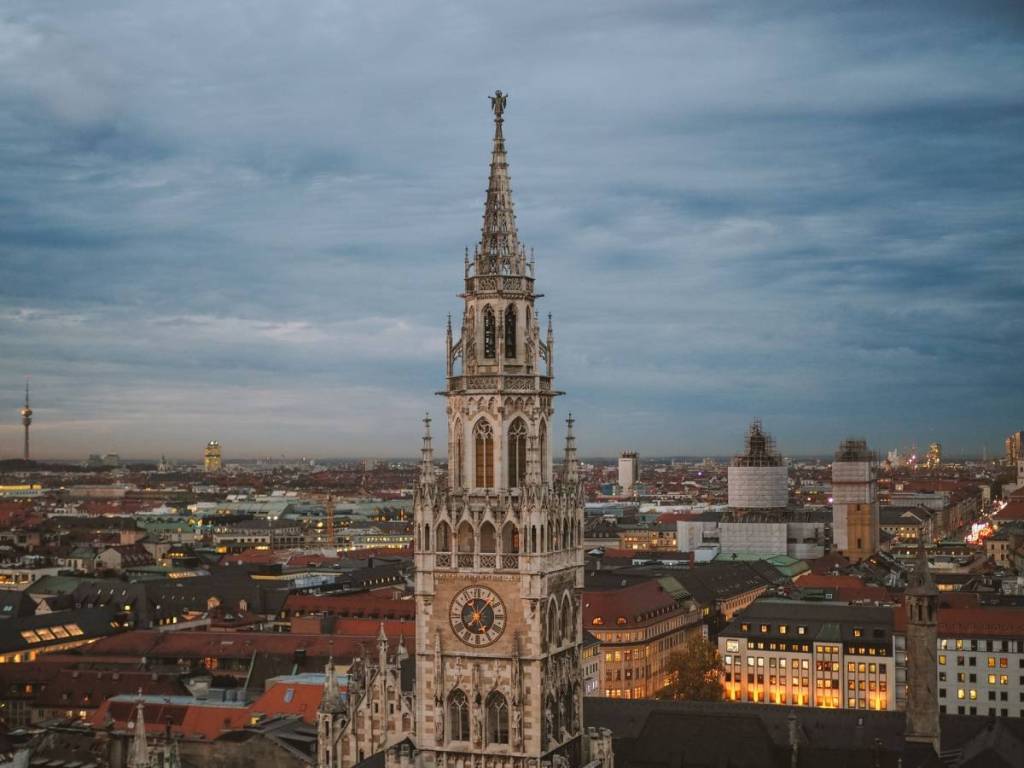

We’ve walked past Munich City Hall hundreds of times, and yet many details have eluded us so far. While the well-known glockenspiel chimes away and all the tourists whip out their cell phones, we weave our way through the crowds and try to continue on our way. So it’s no wonder that we’ve never noticed the Lindwurm perched above our heads at the southwest corner of the building. Maybe you feel the same way and have never consciously noticed the “Wurmeck” or paid it much attention. Yet there’s an exciting legend behind it, one that’s immortalized in the sculpture.
The dragon that brought the plague
As in so many German cities, the plague raged in Munich during the Middle Ages. According to legend, a Lindwurm is said to have brought the disease into the city and spread it. At Marienplatz, it emerged from a hole, breathed its poisonous breath into the alleys, and made people sick. Hardly anyone dared to leave their homes anymore, but a few brave citizens stood up to the monster. Although they managed to defeat the dragon, the residents of Munich remained confined to their homes. It was only the Schäffler who, with their dance, were able to coax people back outside.
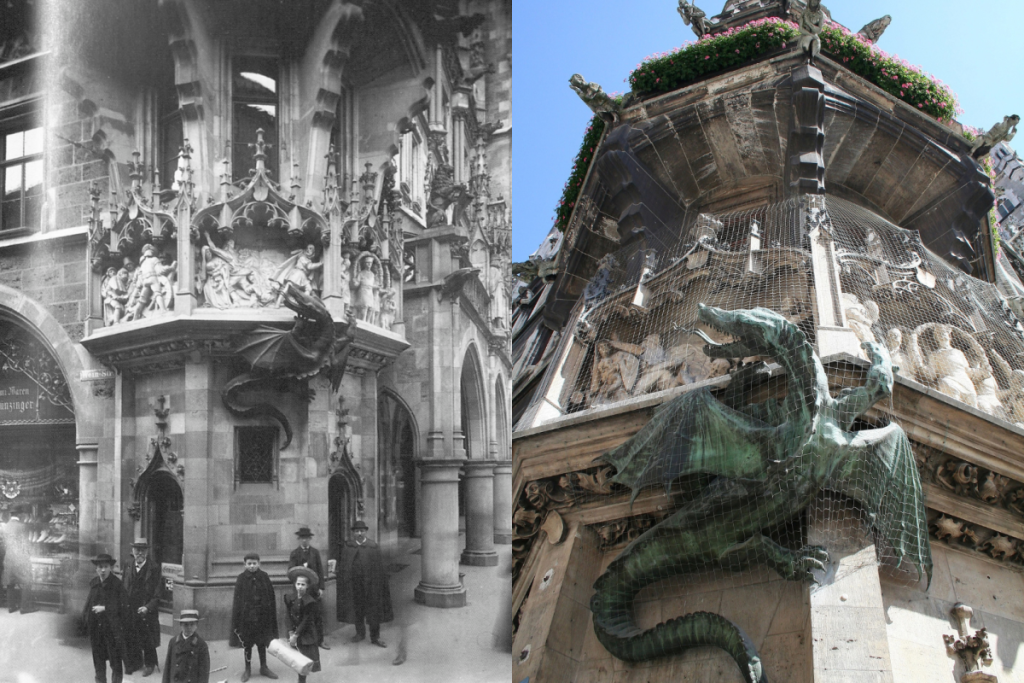
Today, the Wurmeck commemorates this legend with its depiction of the Lindwurm and the triumphant coopers. In fact, however, the coopers’ dances have only existed since the 17th century— long after the last wave of the plague in Munich. So the idea that the dances originated at the end of the plague is merely a myth. Before the town hall was built, an old townhouse stood on the site, which had borne the name “Wurmeck” since at least 1431. It belonged to the Schönecker family of Augsburg, whose coat of arms was adorned with a panther. People presumably misinterpreted this mythical creature as a dragon, which is why they supplemented its depiction with Saint George, who slew it. This is likely how the house name “Wurmeck” came to be, and later, the legend of the plague dragon developed from it.
The Wurmeck at the New City Hall
Even though the old town hall had to make way for the New Town Hall, the “Wurmeck” has been preserved. At the spot where Weinstraße meets Marienplatz stands a corner tower crowned by a dragon. Anton Keindl sculpted the bronze figure that soars upward here. To the left and right are two stone reliefs depicting the legend. In the left panel, you can see not only people fleeing but also the brave citizens arming themselves to confront the Lindworm. On the right, meanwhile, the Schäffler dancers celebrate their victory.
So the next time you’re at Marienplatz, don’t just rush past City Hall. Instead, take a moment to pause at the “Wurmeck.” While you’re there, let your gaze wander a bit further to the gargoyle on the third floor. It, too, references the legend of the plague dragon. And perhaps you’ll discover a few more details on the New City Hall that you’ve never noticed before.
