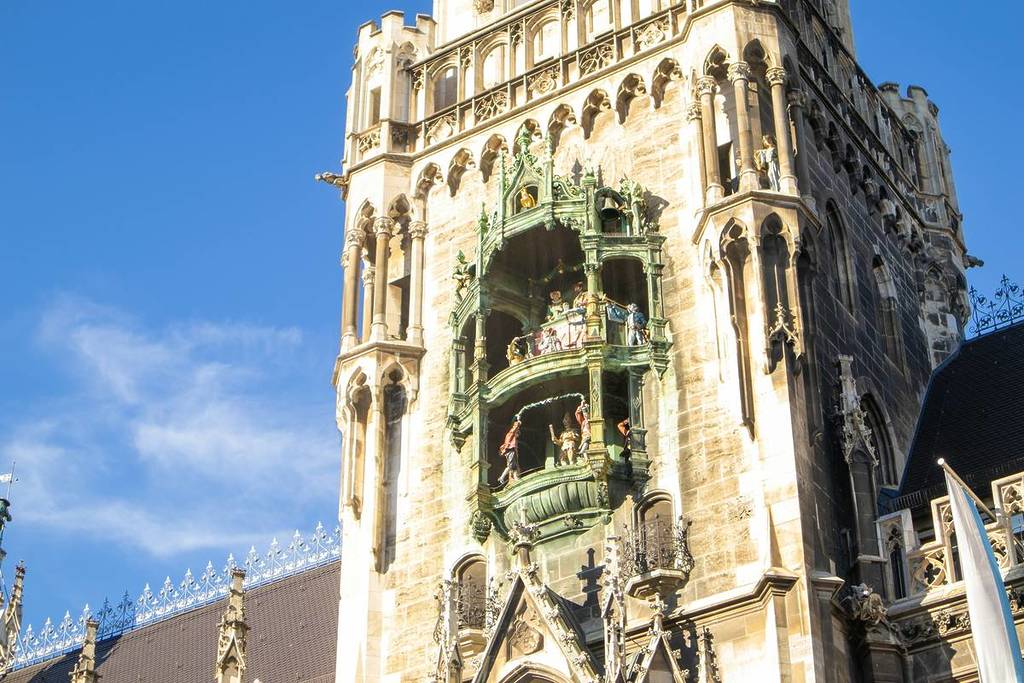
Marienplatz is the heart of Munich and as such it pulsates with life every day as tourists and locals flock to the square. There is much to discover here, some less obvious, such as the “Passage” art gallery, while others present themselves quite openly, such as the old St. Peter’s or the two town halls. Above all, the imposing, neo-Gothic building of the new town hall towers impressively over the square and is the first thing that catches your eye when you return to daylight from the underground and S-Bahn. But the new town hall is not only a popular photo motif because of its architecture. Every morning at 11 a.m., people stop here in rows and turn their gaze towards the town hall tower to watch a very special spectacle.
A Munich institution for over 100 years
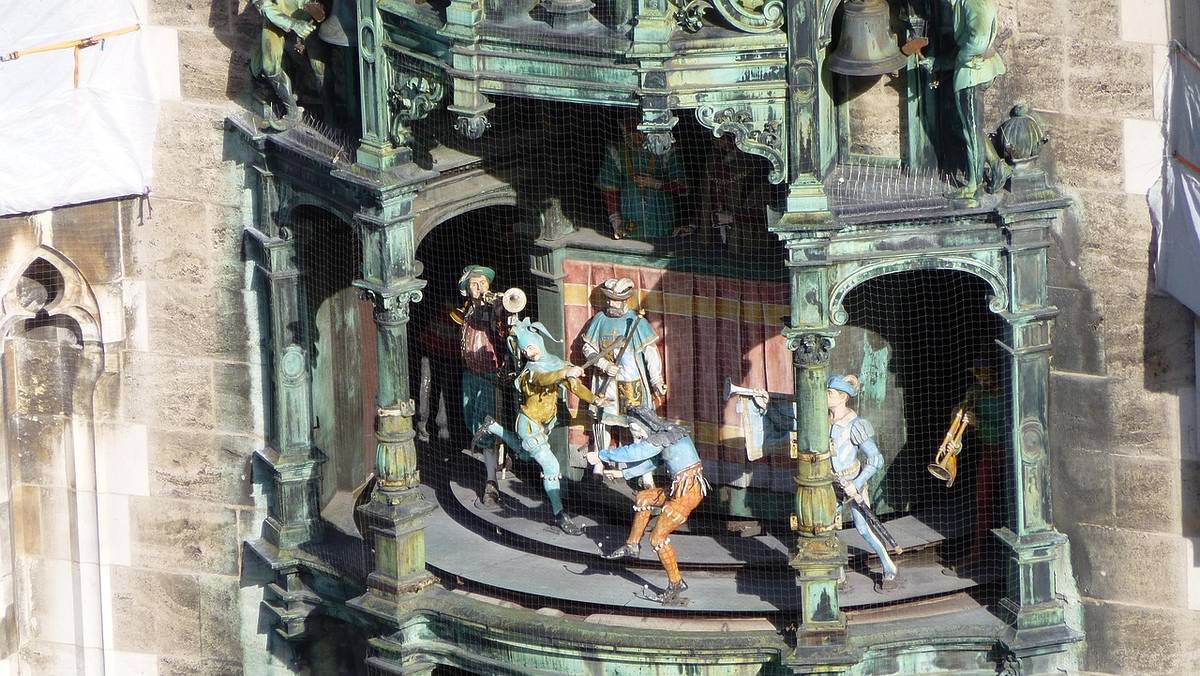
Since 1909, the bells have been ringing out from the town hall tower and the life-size figures begin to move and dance. The carillon on Marienplatz has always fascinated visitors with its attention to detail and the story it tells. The idea for the carillon came from architect Georg von Hauberrisser, who was also responsible for the realization of the new town hall. It was completed in 1908, but could only be heard regularly from the following year, as the sound of the bells was initially unsatisfactory.
There are 43 of them, the smallest of which weighs 10 kilograms and has a diameter of 18 centimetres. The largest bell has a proud weight of 1,300 kilograms and measures 125 centimetres; all the bells together weigh a full 7 tons. The melodies come from six chimes, which are changed every month to provide a seasonally appropriate repertoire. Thirty-two life-size figures then move to the music and dance for 12 minutes for onlookers.
The carillon on Marienplatz was the first electromechanical carillon in Europe at the time and is now the fifth largest of its kind on the continent. It used to only play at 11 a.m., but since the 1972 Olympic Games you can also watch the spectacle at 12 noon and from March to October at 5 p.m. as well. At 9 pm, the night watchman and the Münchner Kindl bid farewell.
The most important information at a glance:
- Weight: All the bells together weigh 7 tons, the heaviest alone 1,300 kilograms.
- Figures: 32 life-size actors dance on two levels.
- Duration: The entire show lasts around 12 minutes, the night greeting 2 minutes.
- Special feature: It was the first electromechanical carillon on the continent.
- Times: Daily at 11am, 12pm & 9pm (except Good Friday), from March to October also at 5pm.
What does the carillon on Marienplatz represent?
The Spielerker of the Glockenspiel is divided into two levels or floors. On the upper level, you can watch a jousting tournament that took place on Marienplatz in 1568. It was held to celebrate the wedding of Duke Willhelm V and his wife Renate of Lorraine after they had married in the Frauenkirche. Renate and Wilhelm can be seen in the center, watching over the event. A knight in gold armor and one in silver armor ride towards each other, lances raised. We won’t tell you at this point which of the two will win.
At the end of the tournament, the Schäffler begin to turn on the lower level. They perform the traditional Schäffler dance, which you only get to see in real life once every seven years. This dance is said to date back to the plague of 1515. Back then, the Schäffler are said to have tried to lure people back onto the streets to take part in public life.
In the evening at 9 pm, you will finally get to see another performance. Small bay windows open on the left and right sides of the town hall tower. The night watchman steps out on the left and makes his rounds with his dog, accompanied by the night watchman’s call from Richard Wagner’s opera “Die Meistersinger von Nürnberg”. After completing his rounds, Johannes Brahms’ lullaby is played and the Münchner Kindl and the Angel of Peace appear. After two minutes, the Glockenspiel bids farewell to Munich and its visitors into the night.