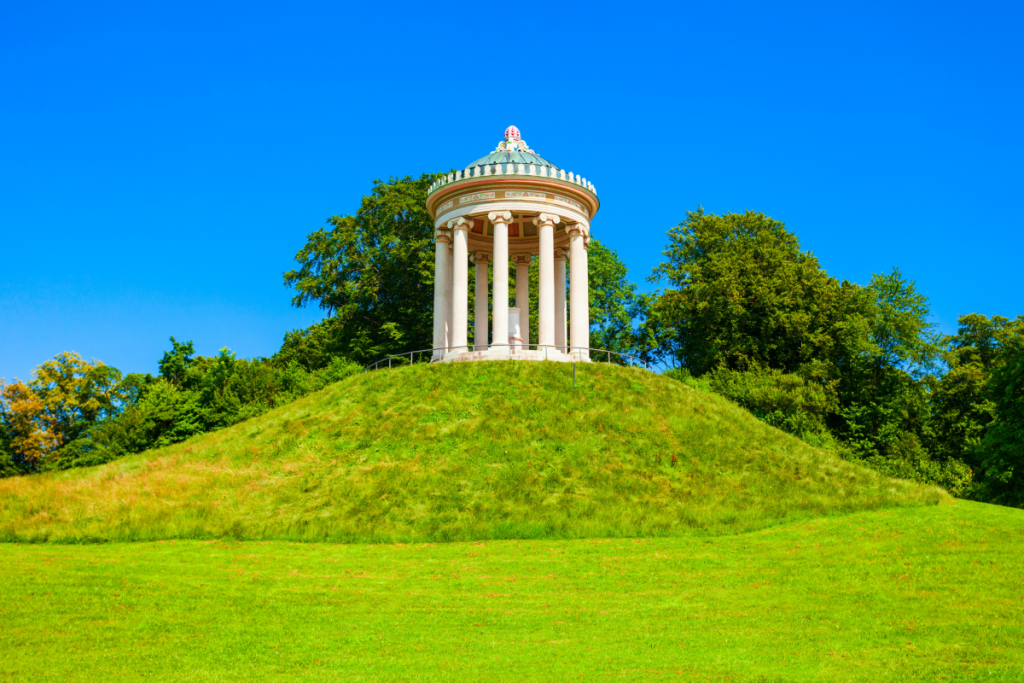

Rising 15 meters above the English Garden, the Monopteros stands as a symbol of what is arguably the world’s largest inner-city park. When the sun’s rays shine down on Munich, locals and tourists alike gather around it, and in the evening it becomes a popular spot to watch the sunset. But even though most of you have surely walked past it hundreds of times, very few of you probably know the story behind the structure.
The Greek Temple in the English Garden
Although Munich’s largest park is modeled after English landscape gardens, it’s quite international: a Chinese tower, a Japanese teahouse, a Greek temple, and an amphitheater can all be found here. As early as 1807, landscape architect Friedrich Ludwig Sckell had the idea for a Pantheon in Munich. When his nephew Carl August proposed this idea to Ludwig I—who wanted to turn Munich into an “Athens on the Isar”— it fell on fertile ground. Ludwig I commissioned Leo von Klenze to design the ancient circular temple, which he began constructing in 1832.
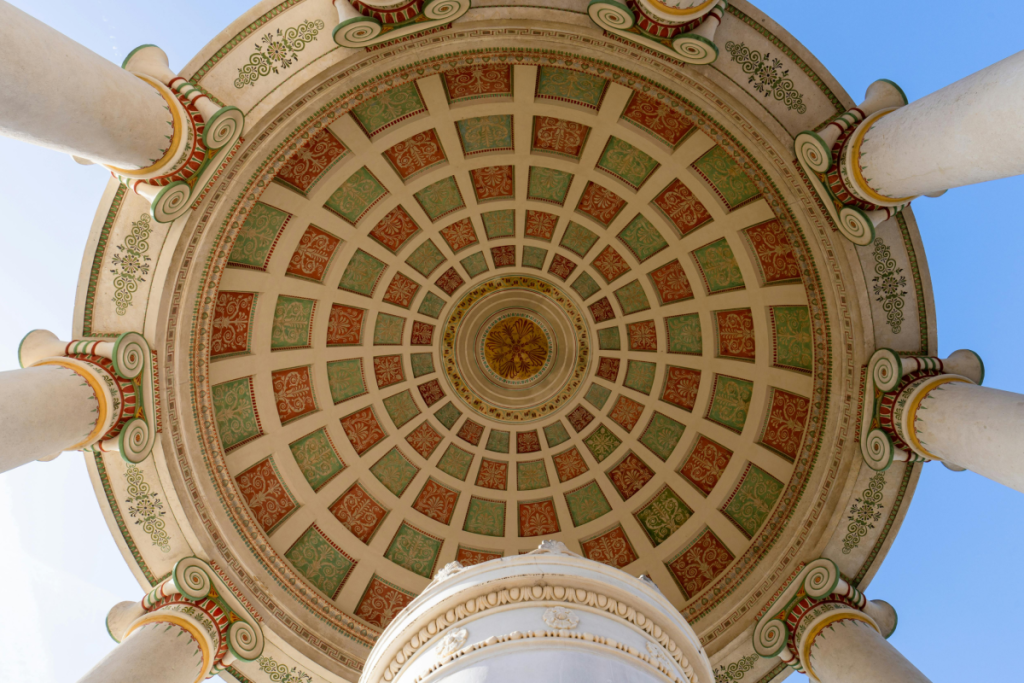
First, a 15-meter-high brick foundation was built, which Carl August concealed beneath a hill. Like the Perlacher Mugl and the Olympiaberg, the hill in the English Garden is therefore not real. The Monopteros was then constructed according to Klenze’s design using Kelheim limestone by 1837 and features a domed roof with intricate ornamentation, supported by ten columns. The temple itself stands 16 meters tall, making it slightly taller than the hill on which it sits. Over the years, it has undergone several renovations, most recently from 2014 to 2016. During that time, spotlights were added to illuminate the Monopteros after dark.
The Monopteros as a Meeting Place

In the 1960s, street performers and hippies increasingly flocked to the Monopteros and the Schönfeldwiese. While this was considered a scandal in the city at the time, it also helped Munich project an image of being cosmopolitan and tolerant. Thus, the Monopteros not only became a popular meeting place but also a symbol of the Isar metropolis’s cosmopolitanism. To this day, the round temple has lost none of its popularity as a gathering place—quite the contrary.
People from all over the world gather beneath its dome or on the meadows at the foot of its hill—whether to enjoy the view, play volleyball, or have a picnic together. In winter, the slope is perfect for sledding. Today, the whole city gathers here—not just Munich’s alternative scene. And so , a royal temple has become a place for everyone .