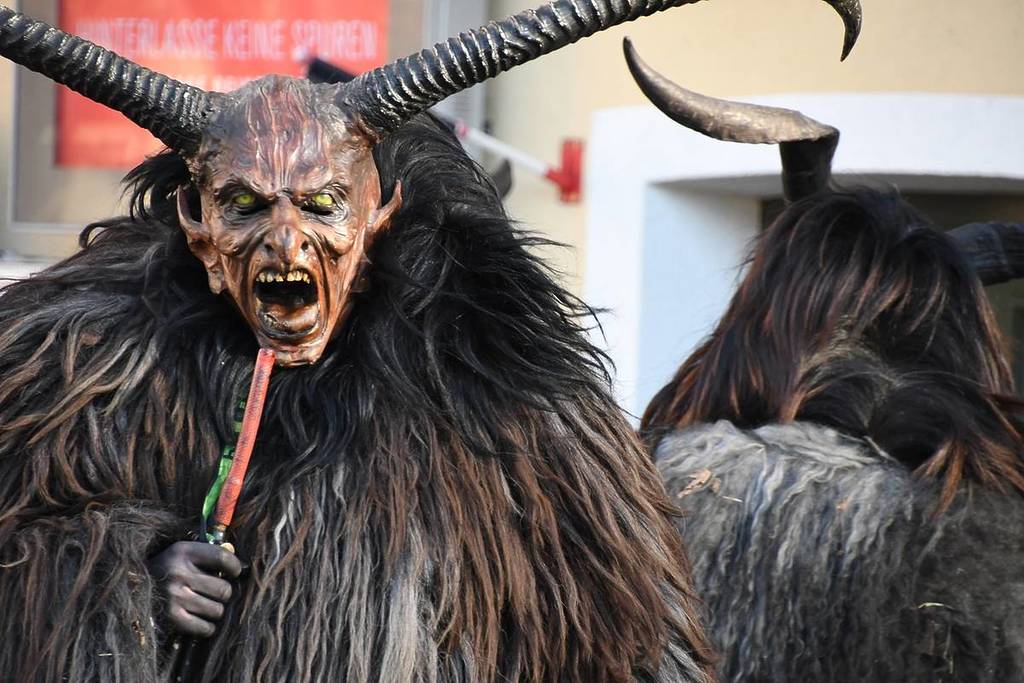
Whereas in other regions of Germany St. Nicholas is accompanied by Knecht Ruprecht, the Bavarian counterpart is Krampus. Unlike the servant with his rod, the Krampus is not human, but has a demonic form. However, both fulfill the same purpose: they punish bad children, while St. Nicholas gives presents to the good ones. What exactly is Krampus and the tradition all about and how is it celebrated in Munich?
A demon from pre-Christian times
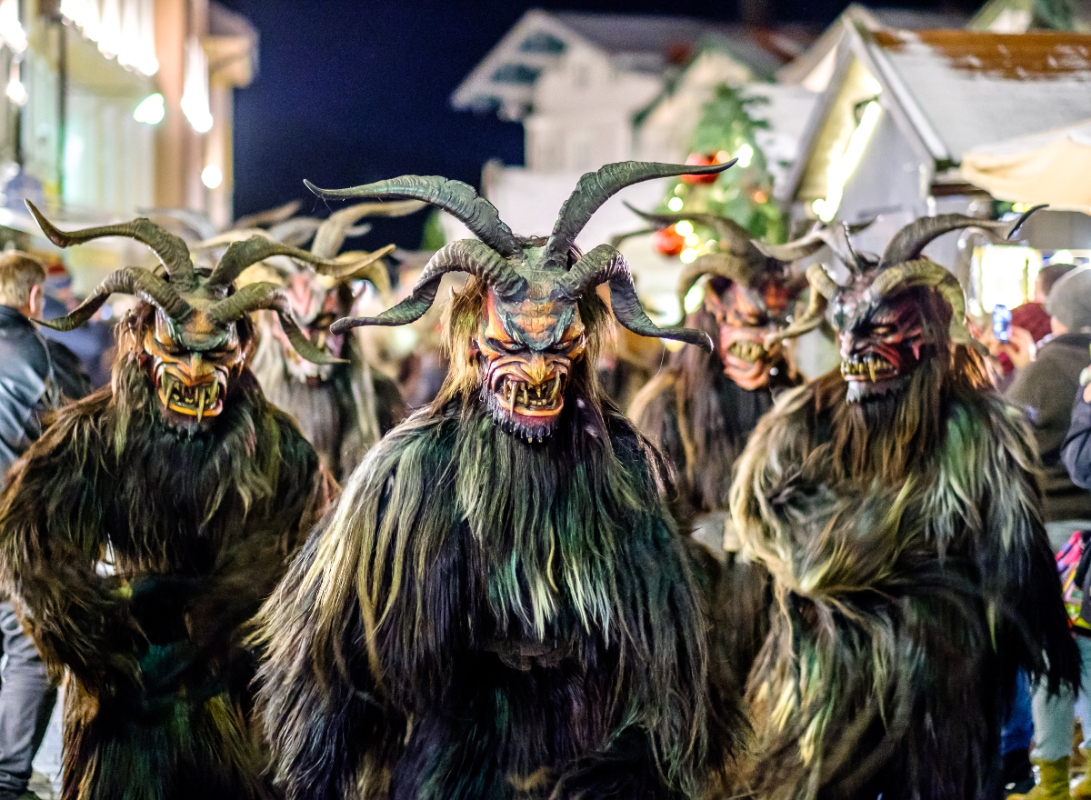
The figure of Krampus is widespread throughout the Eastern Alps and has been around since pre-Christian times. He can be found not only in Bavaria and Austria, but also in Slovenia, Croatia, parts of northern Italy, Liechtenstein, Hungary, the Czech Republic and Slovakia. The name is probably derived from the Middle High German “Krampen” for claw and the Bavarian “Krampn” for something lifeless or withered. In Bavaria, the group around St. Nicholas and Krampus is sometimes also referred to as “Bass” or “Pass”.
The custom surrounding the frightening figure goes back many hundreds of years. They were already roaming the streets of towns and villages in the Alpine regions in the 16th century. The Krampus’ visit to people’s homes together with St. Nicholas, on the other hand, is more recent. This tradition only became established towards the middle of the 17th century.
In most cases, St. Nicholas is accompanied not just by one, but by several Krampuses, who are supposed to scare the children. This is another way in which he differs from Knecht Ruprecht, as is his appearance. The Krampus is usually a horned demon with pointed teeth and long fur; the face is contorted into an evil grimace. Krampuses can also be equipped with rods or tails, as well as a so-called Butte or Kraxn, which they carry on their backs. They are said to have taken naughty children with them in this container.
However, what exactly a Krampus looks like and what he carries differs from region to region. In some places, they don’t wear a mask and simply carry their fur, in others they are dressed in potato sacks and in others they carry a cowbell. The names also differ and in some places Krampus are mixed with Perchten. They are said to parade around the houses during the Raunächte and bring good luck to the residents.
The Krampus run as a tradition
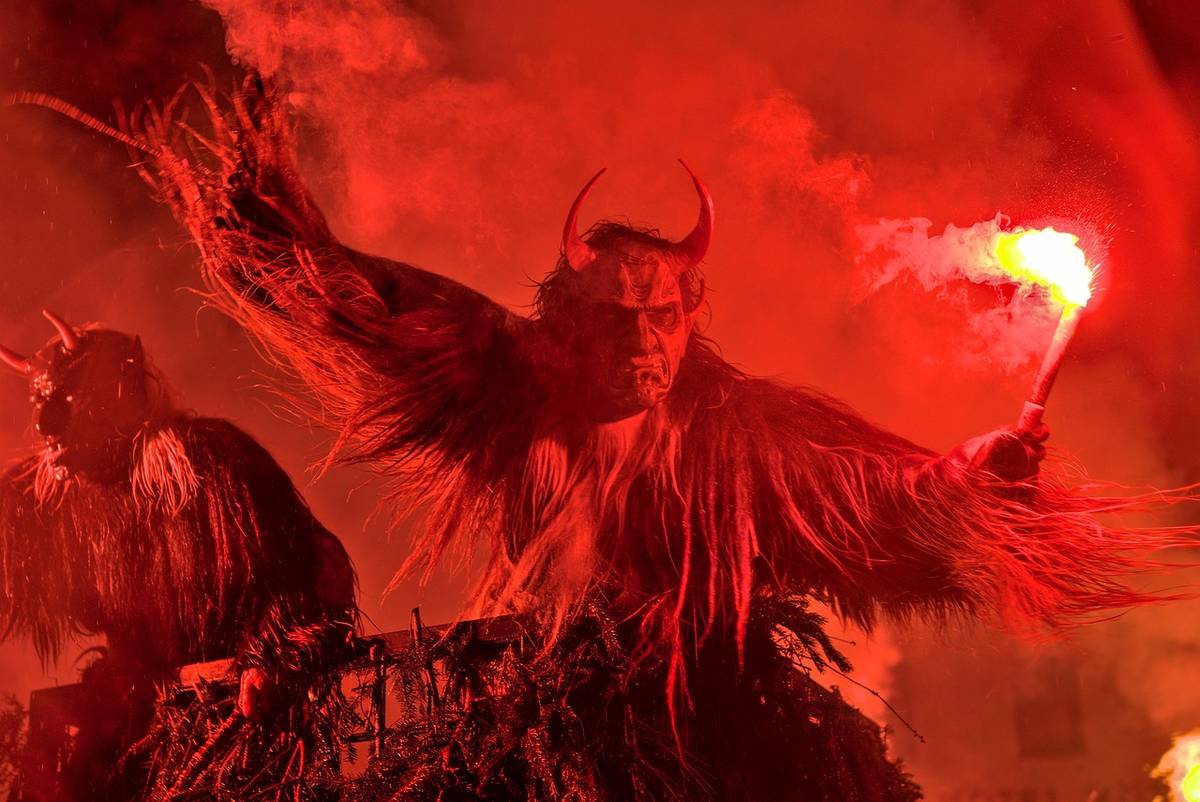
The so-called Krampus is an integral part of the Krampus tradition. Traditionally, December 5th is Krampus Day, but the runs are sometimes held in November and late into December before being replaced by the Perchten runs. In some cases, however, Perchten runs also take place at the beginning or middle of December, reflecting the blending of traditions.
The Perchten runs can vary greatly depending on the region. In some places, the frightening figures parade through the streets with torches, in others they make noise with cowbells. In some places, rods are still used by the Krampuses to hunt down passers-by, although this has repeatedly led to public criticism.
Krampus runs in Munich and the surrounding area
In Munich, the Krampus run takes place this year on December 14 from 3 p.m. to 5 p.m. and leads through the city center and across the Christkindlmarkt. Krampus, Perchten and Klause from 25 groups mingle here to form a crowd of around 300 frightening figures who parade through the streets. Tens of thousands of onlookers watch the spectacle every year, locals and tourists alike. The run starts in Augustinerstraße and leads through the city center and across the Viktualienmarkt to the Old Town Hall.
But there are also numerous Perchten and Krampus runs around Munich. The first runs will take place in Traunstein and Ruhpolding on November 20 and 21. The largest Krampus run in Bavaria is traditionally held in Freilassing with up to 70 participating groups and over 1,000 Krampuses. However, no date has yet been announced for this year. Another well-known parade is the Salzburg Gnigler Krampus Run on November 29, where over 900 runners are expected.