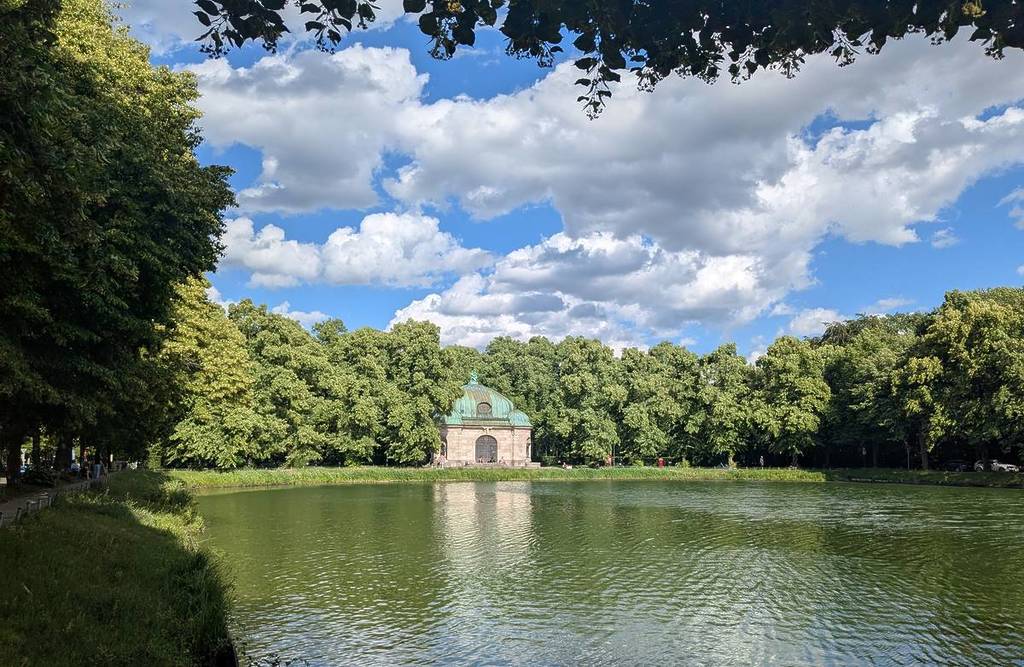

When the sun is blazing in the summer, Munich residents are drawn to the city’s parks, where they seek refuge from the heat in the shade of the trees. Naturally, the southern part of the English Garden and the Nymphenburg Palace Park are particularly popular. In the latter, you can glide along the canal in a gondola and feel like you’re in Venice. But who among you has actually ever been to the other end of the Nymphenburg Palace Canal? At its end lies Grünwald Park, home to a true architectural gem. So if you’d like to discover a new corner of Munich, be sure to stop by here on your next outing to the countryside.
Small, but impressive
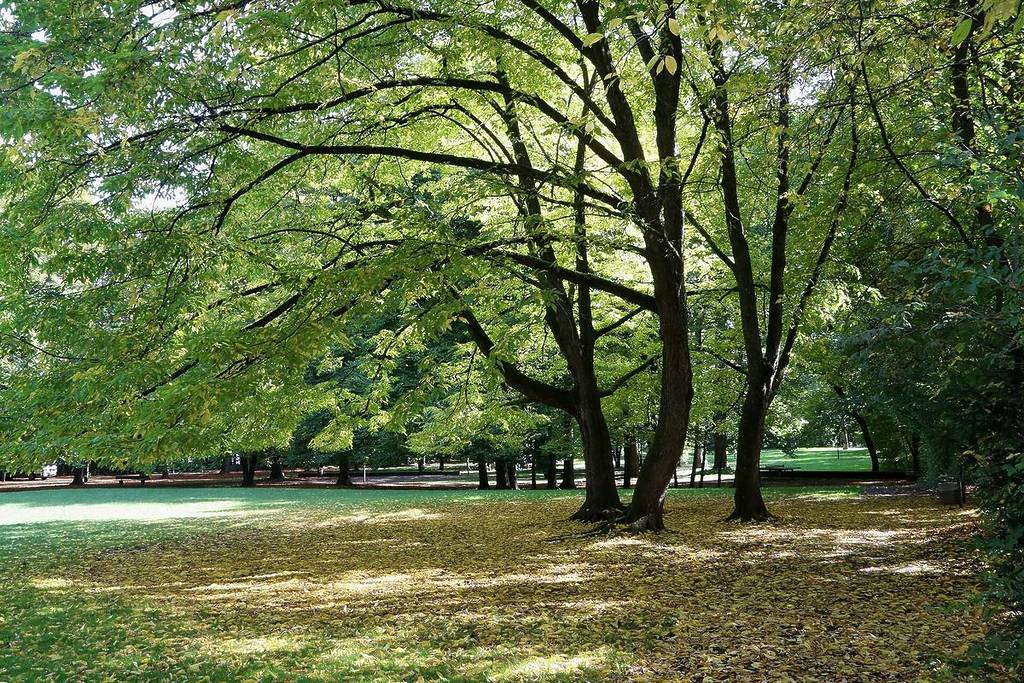
With its three hectares, Grünwaldpark is one of the smaller parks of its kind in Munich and is therefore likely to go unnoticed by many. Yet, despite its compact size, it has a lot to offer. If you enter Grünwaldpark from the south, it seems very unremarkable at first, yet the first unique feature is right there. A tram loop runs through the southern end of the park , which has been there since 1892. Back then, the white line of the horse-drawn tram—a tram pulled by a horse—ran between Grünwaldpark and Adalbertstraße.
Grünwald Park offers plenty of shade, so you won’t be exposed to the sun on hot days and can relax, read, or have a picnic here. If that’s too boring for you, the park has plenty of activities to offer. Kids can let off steam on the spacious playground while you compete in a game of table tennis or streetball . In winter, the hill in the park turns into a top-notch sledding hill. The real highlight, however, awaits you at the northern end of the park, which requires crossing the street.
The Hubertus Fountain at Grünwald Park
As soon as you emerge from the trees and cross the Südliche Auffahrtsallee, you’ll spot it: the Hubertus Fountain. It’s located at the eastern end of the Nymphenburg Palace Canal. From the fountain, you can look across the water to the palace itself, which towers majestically in the distance. The fountain itself is also very impressive and far less well-known. Even on a sunny Saturday, only a few people gather at its base to enjoy the view across the canal. A stone bridge spans the canal just a few meters away, from which you can look either toward the palace or the fountain.
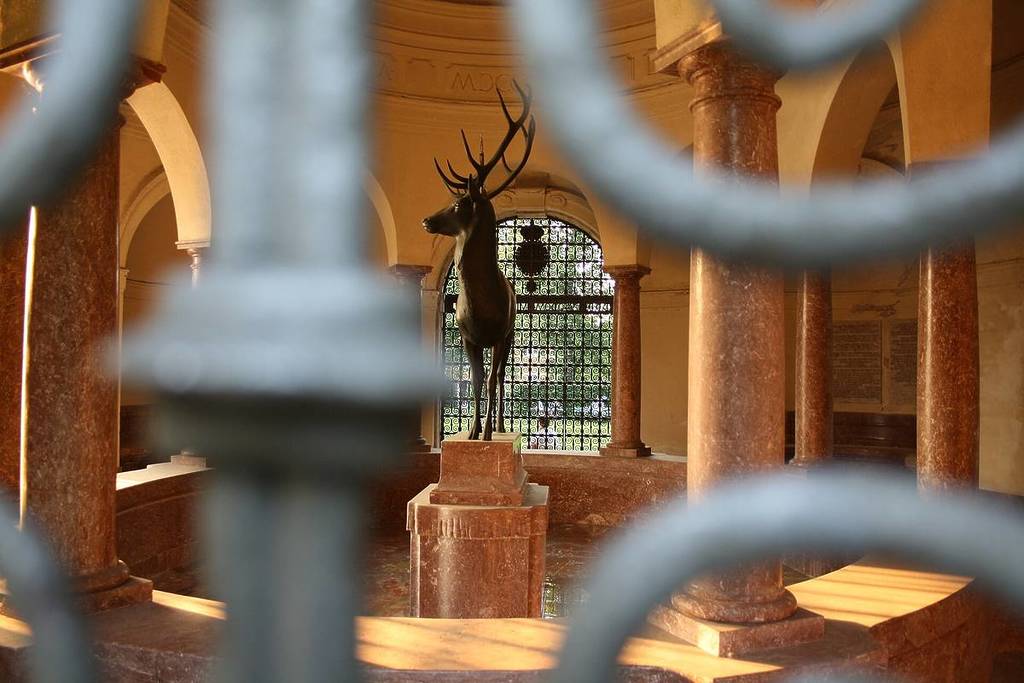
The Hubertus Fountain was built between 1903 and 1907 in honor of Prince Regent Luitpold’s 85th birthday and originally stood in front of the National Museum. The sculptor Adolf von Hildebrand was responsible for its creation. During the Nazi era, it had to make way for the Nazis’ plans and was not rebuilt until 1954 at its current location near Grünwald Park. The fountain is built in the shape of a temple and features an oval water basin inside, with a statue of a stag standing in the center . The columns supporting the vault are made of marble. You can’t enter the pavilion, but you can look inside from the outside.
Outside, there is a figure at each of the fountain’s four corners: the young huntress, the root woman, the old hunter, and the archer. You can sit down at their feet. Perched on the roof is Saint Hubert, the fountain’s namesake. The Hubertus Fountain is particularly impressive for its size and Baroque architecture, which is why it rightly bears the nickname “Hildebrand’s Jewel.” You can sit right by the fountain or on one of the benches along the Schlosskanal. Or you can simply take a short stroll under the trees and return across the bridge to Grünwaldpark.