Anyone traveling in Munich can hardly avoid the subway. The city is criss-crossed by an underground network that reliably gets locals and visitors alike to their destinations. Some of the underground stations are so old that they can look back on special histories. For example, a river once flowed at Marienplatz, while the Westfriedhof station was just a lucky coincidence. Goetheplatz subway station has a particularly dark past.
Unsurprisingly, it was named after the world-famous German poet Johann Wolfgang von Goethe. But Goethe was not the only famous person to play a major role in this subway station. In fact, part of this very subway tunnel is associated with none other than Adolf Hitler. Goetheplatz has a historical significance that very few people know about.
Subway train my ass: there was an air raid shelter under Munich here
The station was opened on October 19, 1971. But the planning and initial construction work for Goetheplatz began as early as 1938 – under the National Socialist Adolf Hitler. The construction of a 580-metre-long tunnel section under Lindwurmstraße – which also includes the area of today’s Goetheplatz – was started before the war. The Nazi regime wanted to upgrade the “capital of the movement”.
However, it did not get very far with this. In July 1941, construction work was halted due to the Second World War – after 590 meters, the tunnel was finished. Men and materials were needed more urgently for the war. What was already finished was given a new purpose: this shell served as an air raid shelter during the Second World War,
It was only in the post-war period that it was reused in its actual function and repurposed as a subway tunnel. From 1971, the modern subway line as we know it today was built here. This was the southern terminus of the very first Munich subway line (U3/U6)! It retained this status until the line was extended to Implerstraße in 1975.
From Nazi creations to modern architecture
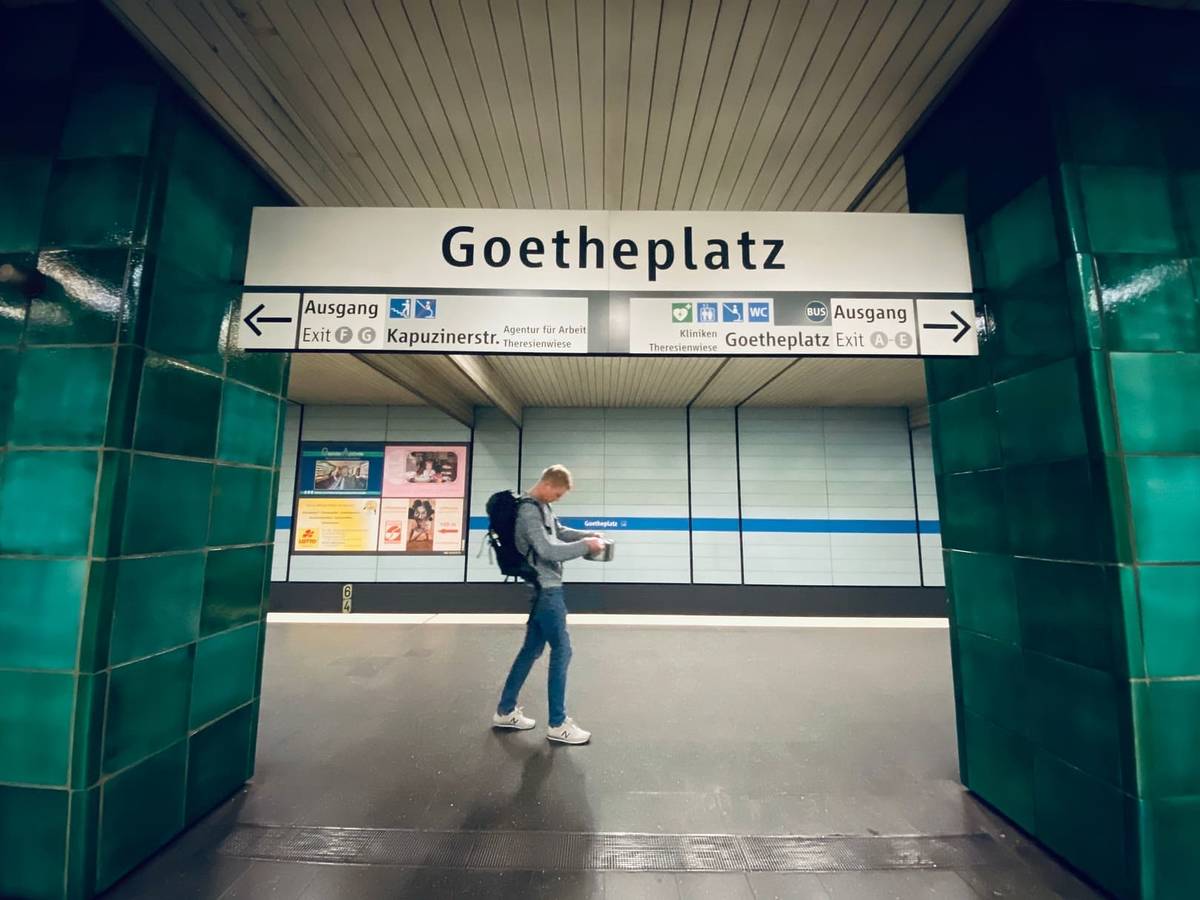
Today, Goetheplatz subway station is an important junction and of particular historical significance for the Munich subway. At around 135 meters, the platform is also a little longer than the usual 120-meter platforms. And the old Lindwurm tunnel from the 1940s now leads into one of the city’s most popular stations: Sendlinger Tor.
And its architecture is also impressive. The station was designed by architect Paolo Nestler as part of the uniform color concept of the first subway line. Anyone who has ever got on or off the train at Goetheplatz will know that the station’s distinguishing color is various shades of green, which can be found on the ceramic tiles of the supporting pillars. Where once Nazis were at work, we can now look forward to fresh colors.