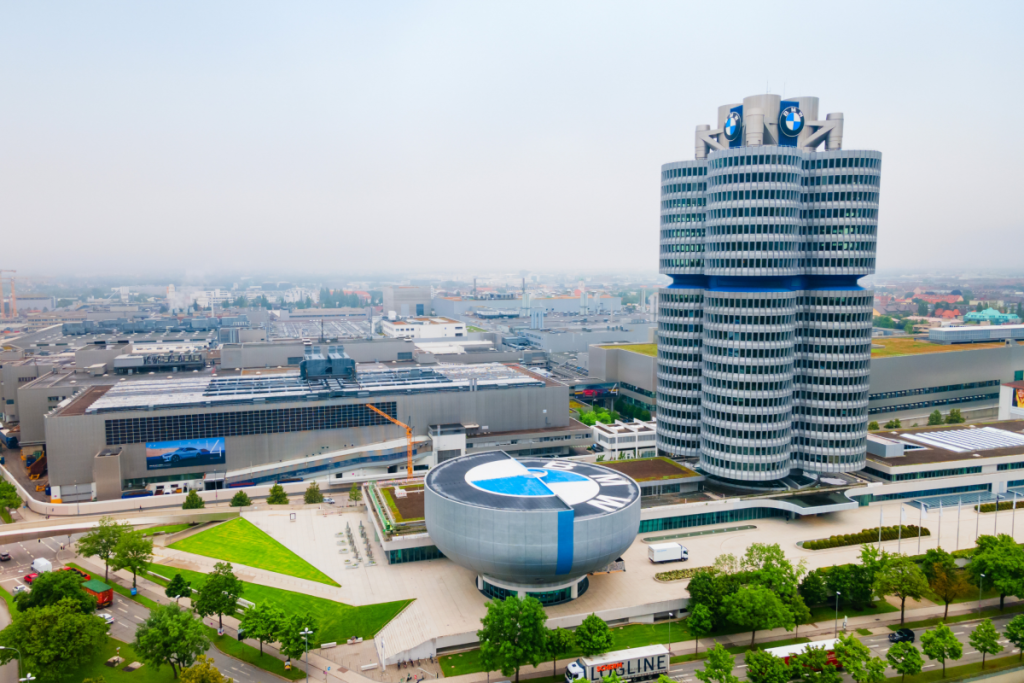

Munich is home to numerous structures that are several centuries old and continue to captivate visitors today with their medieval or Baroque charm. But buildings from the more recent past also shape the cityscape and demonstrate that modern architecture, too, can achieve cult status. Popular examples of this include the Arabellahaus and the BMW “Four-Cylinder” at the Olympic Park. The latter not only looks spectacular but also has a fascinating construction history.
From top to bottom
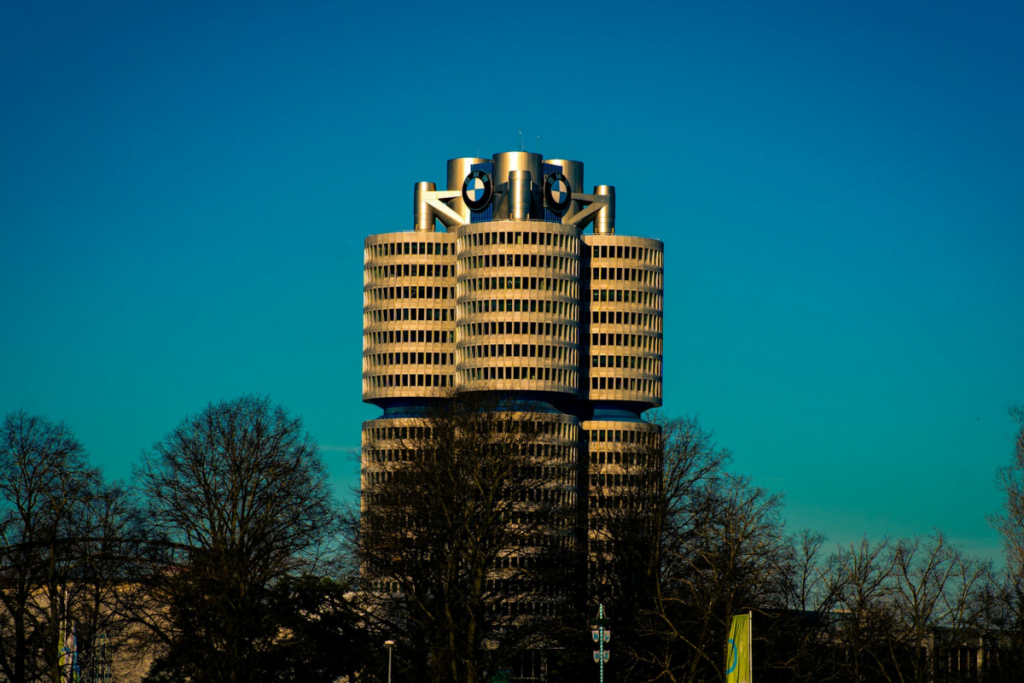
Construction of the BMW Tower began in 1968 on Petuelring and was completed in 1973. Externally, however, the building had already been finished the previous year in time for the start of the Olympic Games. The architect was the Austrian Karl Schwanzer, who designed both the new headquarters and the BMW Museum. The corporate headquarters is designed to resemble a four-cylinder engine and, accordingly, consists of four long, cylindrical building sections. Instead of building them from the bottom up and stacking them floor by floor as is customary, the process was reversed. Individual building sections were constructed and completed at ground level, then hoisted upward hydraulically.
On the one hand, this saved time; on the other, it made it possible to do without large scaffolding. In fact, the “cylinders” do not stand on the ground but are suspended from four reinforced concrete columns hidden inside them. At 101 meters, the BMW “Four-Cylinder” was also Munich’s tallest office building upon its completion, before the Hypo Tower in Arabellapark surpassed it in the late 1970s. The building has been a designated historic landmark since 1999, and extensive renovations took place from 2004 to 2006.
The BMW “Vierzylinder” as a Film Set
The Bavarian automaker’s headquarters is now over 50 years old, yet it stands today—just as it did then—as a symbol of innovation and engineering excellence. To mark the anniversary three years ago, 12 dancers performed an impressive vertical routine on the building’s facade. After all, this facade shapes the cityscape just as much as the Frauenkirche or the Alte Peter. And the BMW Film Cylinder has also made appearances in movies. In the 1975 American science fiction film *Rollerball*, it serves as the headquarters of a mega-corporation. The 1977 Italian horror film *Suspiria*, on the other hand, shows the building in the background as a convention center. Other Munich locations also serve as settings in the horror film, such as the Müller’sche Volksbad or the Hofbräuhaus.
Right next to the BMW Four-Cylinder is the BMW Museum, where fans of the car brand can learn about its history. Because of its shape, the museum is nicknamed the “salad bowl” or “Weisswurst kettle,” but its architecture is no less impressive. Since 2007, BMW Welt, located across the street, has rounded out the complex and attracts visitors with free admission. Whether you’re interested in cars or architecture, you’re sure to find something to enjoy around the Petuelring.