
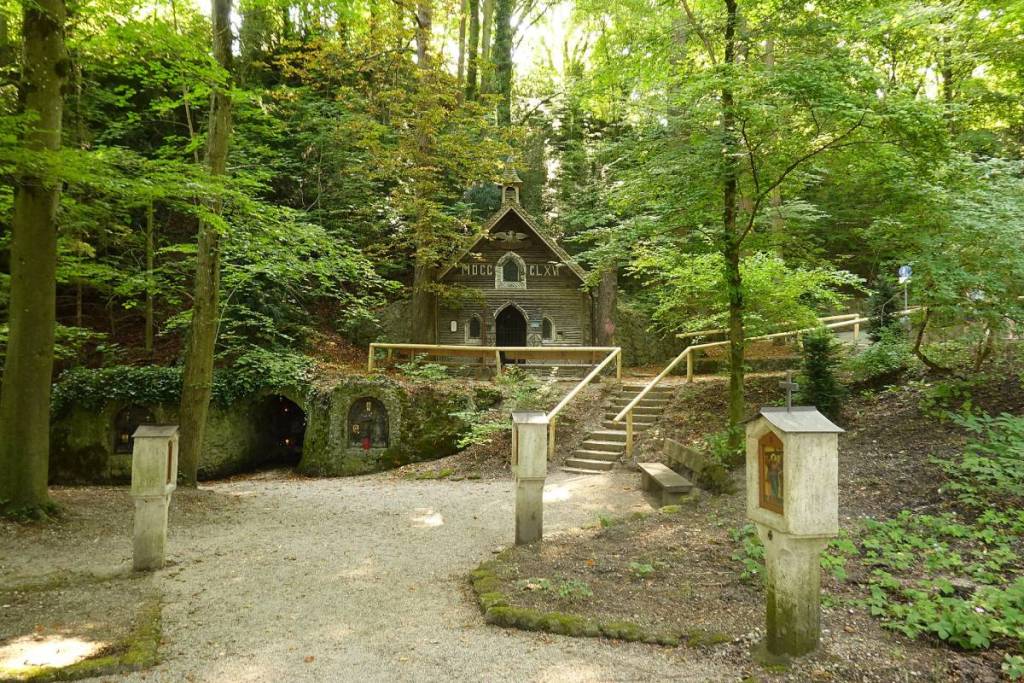

The Isar is always worth a stroll, and since it flows right through the entire city, it offers plenty of variety. Along the way, there are always hidden treasures to discover, such as the street art gallery in the Maximiliansanalgen, the rose garden near the Wittelsbacher Bridge , or the Georgenstein near Grünwald. And you’ll find something special at the Flaucher, too, because the Marienklause is tucked away among the trees at the southern end of the zoo. Here, you can enjoy the peace and quiet and recharge your batteries a bit.
By the wild waters
The Marienklause is part of the Untergiesing-Harlaching district and is thus located on the eastern bank of the Isar, where the river meets the Auer Mühlbach. Since 1330, a weir at this spot has dammed up the water and channeled it into the Mühlbach. There is also a raft slide here, which raftsmen once used to transport goods and materials to Munich—for example, for the construction of the Frauenkirche. In the 19th century , Martin Achleitner worked as a water master at this lock, regulating the water flow here. This work was not without danger, as the weir threatened to break during floods. He reportedly narrowly escaped death on several occasions and believed he owed his survival to the Mother of God, Saint Mary.
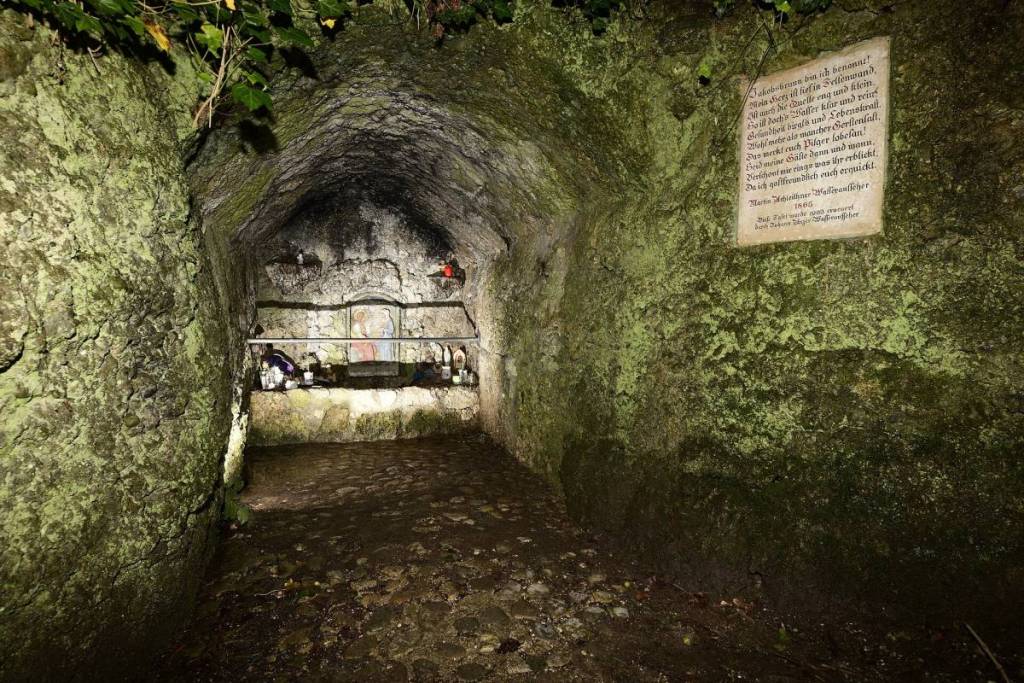
That’s why Achleitner built the small chapel out of wood and stone and dedicated it to Mary, who always seemed to protect him. Below the chapel lies the Jakobsquelle spring, around which the water master created a grotto . It’s adorned with numerous images and statues of Mary, and next to the entrance, a poem written by Achleitner is displayed on a plaque. Next to the spring, you’ll also find other hollows in the rock that contain images as well; visitors often leave flowers and light candles there.
The Marienklause itself is small and simple. Its moss-covered roof is crowned by a small turret, and above the double doors stands an angel holding a banner inscribed with “Marienklause.” It is precisely the simplicity of this wooden structure that gives this place its special charm. Thanks to this, it blends perfectly into the idyllic setting of the surrounding forest and exudes a special sense of tranquility that invites you to linger.
On the Way to the Marienklause
Martin Achleitner not only built the chapel and the spring grotto but also laid out the first winding path leading to them. Today, there are 14 Stations of the Cross along the path, each featuring images set in wooden frames. There is also an open-air altar in the courtyard. Every May, a prayer service is held at the Marienklause, which you’re welcome to attend. Otherwise, it’s worth taking a detour on a walk through the surrounding area to enjoy the idyllic atmosphere of this place.
Today, both the Marienklause with its spring and the Way of the Cross are designated historic landmarks. If you’re coming from the west, the Marienklausensteg leads you across the Isar to the chapel on the steep slope. North of the hermitage lies Hellabrunn Zoo, whose boundary is marked by a fence. With a little luck, you might catch a glimpse over it and spot a few animals.
