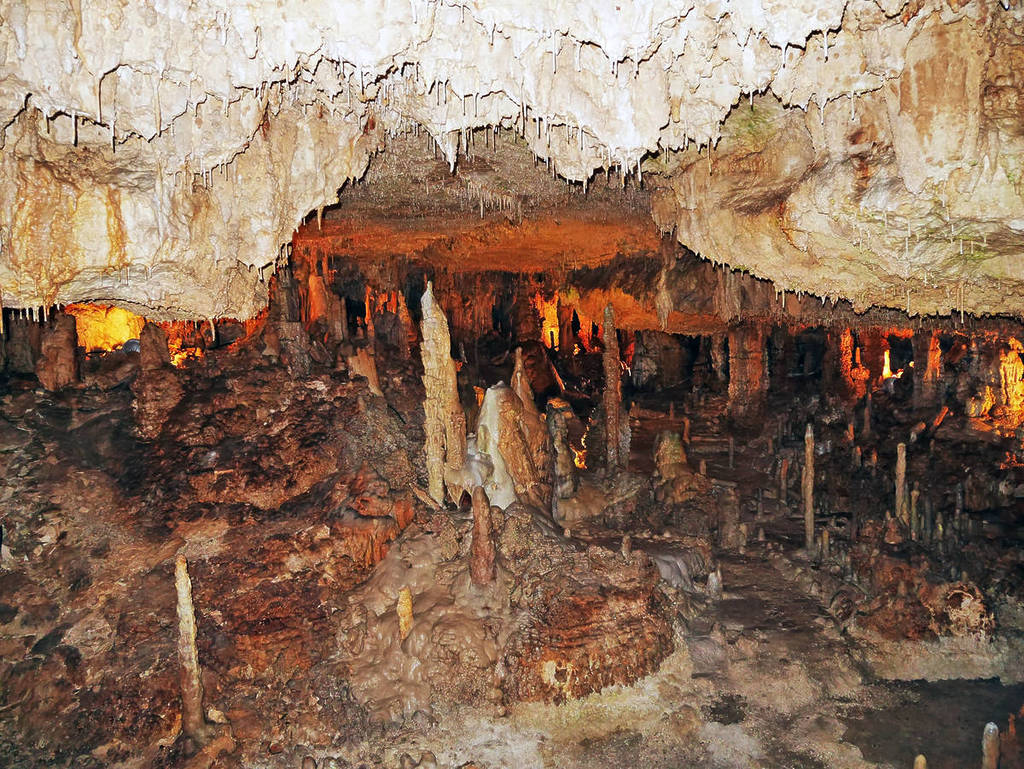
We Munich residents love the lakes and mountains in the surrounding area, but Bavaria has many other natural attractions to offer. Breathtaking sights lie dormant underground, just waiting to be discovered by you. One of the most beautiful show caves is located in the Upper Palatinate, not far from Nuremberg. It impresses with its fantastic ensemble of stalagmites and stalactites and you can visit it for just €8.
Secrets in the depths
The cave remained completely undiscovered until 1895. In that year, on September 30, the shepherd Peter Federl observed a fox disappearing into the mountain and followed it. He cleared a crevice in the rock through which he reached the inside of the mountain. A narrow passage led into the vault of a cave. Before he ventured any further, Peter turned back and got help from the chimney sweep Josef Erl and the mechanic Josef Kuhn. The three of them descended the corridor again and, by the light of the candles they had brought with them, a magical stalactite cave revealed itself to them.
Word of the new discovery spread quickly and the town soon extended the corridors to welcome visitors. The work took eight months until the first guided tours could finally take place in May 1896. Until 1954, these tours were only conducted by candlelight and with magnesium lamps and torches.
In the first half of the 20th century, the cave was continually expanded and fixed staircases were installed. In 1953, electric lighting was installed, which was completed the following year. This meant that torches, which were harmful to the stalactites, could finally be dispensed with. From then on, there were regular guided tours through the expanded show cave.
The Advent Hall
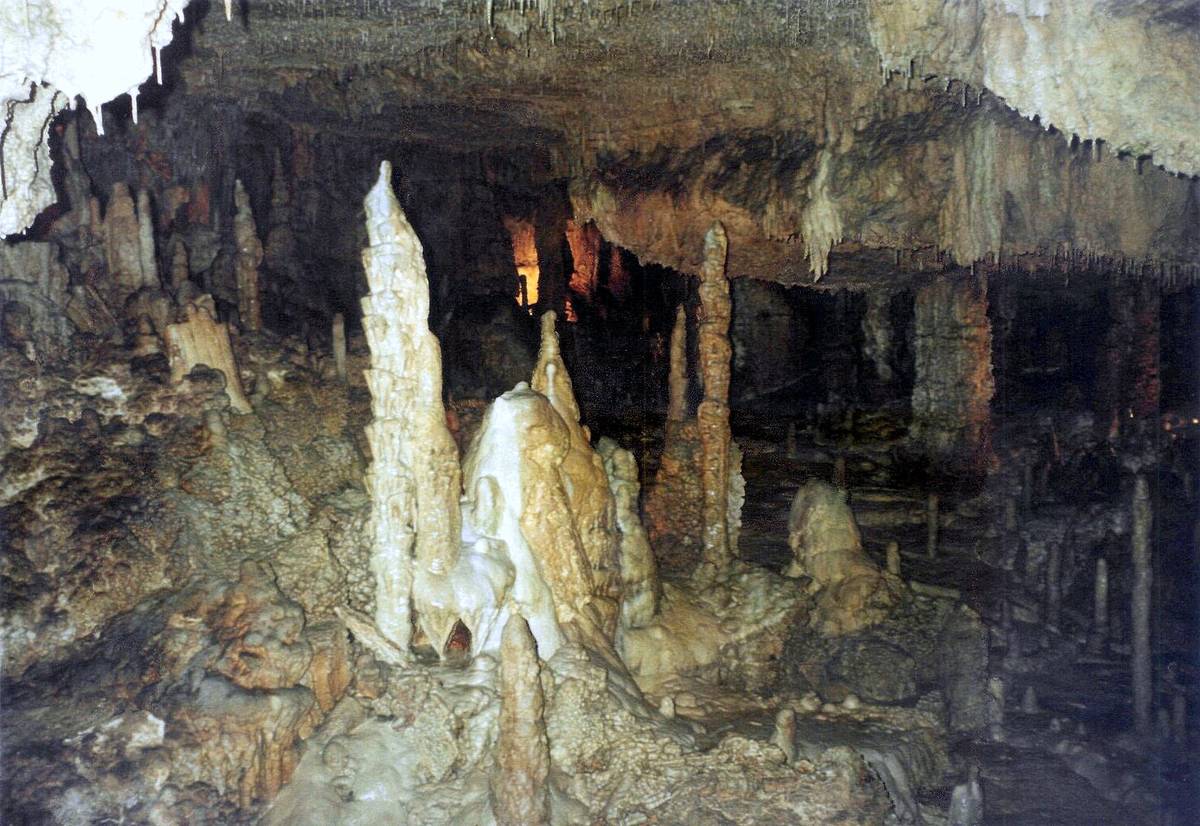
On October 19, 17-year-old Helmut Schlierf and his friend Michael Kirnberger discovered a fissure in the cave, which they had already been exploring regularly for a year. They dug at the fissure until December 1972, in the meantime they were joined by another group of explorers. They passed through the fissure into a grotto with further stalactites. As the discovery of this part of the cave coincided with Advent, it was given the name Advent Hall.
As a result, the hall was expanded and suffered considerable damage. Some of the stalactites fell victim to the construction work or were crushed, and their appearance changed. The Adventhalle was opened to the public for the first time in June 1977.
Despite the interventions, it still impresses with its extraordinary beauty. Unlike in the main hall, guided tours with torches never took place here, so the stalactites are white rather than soot-blackened. The walls of the grotto are covered with colorful sinter beads, which bear witness to the fact that the hall was once filled with water. Some of the stalactites have grown in spirals, for which no plausible explanation has yet been found.
On a discovery tour through the King Otto stalactite cave
https://www.youtube.com/watch?v=5EefzscxUbQ
The cave was discovered on the name day of the Bavarian King Otto, which is why it was named after him. It belongs to the town of Velburg in the district of Neumarkt in de Oberpfalz, just a two-hour drive from Munich. You can visit 270 of the 450-metre-long cave on a guided tour. The tours last between 30 and 40 minutes and you pay an entrance fee of €8.
On your tour through the cave, you will discover many impressive stalagmites and stalactites, some of which resemble objects or people. With enough imagination, you can make out Neuschwanstein Castle, Buddha, a frog or a heart in the formations. In the so-called fairytale forest, the stalactites resemble trees and tree trunks and you can also spot the lovers in between.
Despite its beauty, it does not attract nearly as many visitors as the Devil’s Cave. While an average of 31,000 people a year visited the King Otto Dripstone Cave between 1989 and 1993, the numbers continued to fall in the following years. The cave now attracts around 18,000 visitors a year. The Devil’s Cave, on the other hand, attracts around ten times as many tourists.
The King Otto Stalactite Cave can be visited from the beginning of March to the end of October and is open Wednesdays to Fridays from 11 am to 4 pm and Saturdays & Sundays from 10 am to 5 pm.