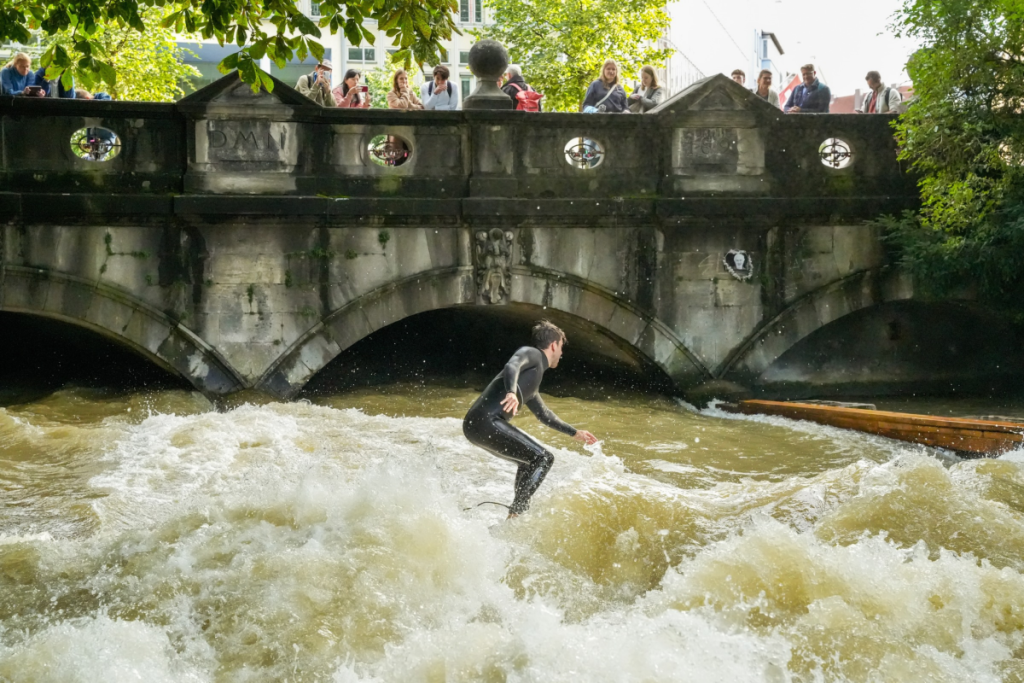

Whether under bright sunshine or in the bitter cold: Today, the surfers in the heart of the Isar metropolis are an integral part of Munich. The birth of this trend can be traced back to the unwavering pioneering spirit of German river surfing pioneer Arthur Pauli. Inspired by the music of the Beach Boys and a record cover in 1963, the boy from Trostberg was determined to surf. But since the ocean was too far away, two years later he simply built himself a board out of plywood and fiberglass and made his first attempts on his local Alz River using a tethered rope. After a later trip to France, he became determined to make “river surfing” more popular on the rivers of Bavaria—and he succeeded!
The Breakthrough at the Ländkanal: From Experiments to the First Championships
In 1971, when Arthur Pauli was enrolled as a mechanical engineering student at the Technical University of Munich, a close friend gave him the crucial tip. At the Ländkanal in Thalkirchen, about 200 meters upstream from the Floßlände, there was a rideable wave. Pauli tied a rope to a pipe on the bank, jumped into the cool water, and the attempt was a success. Just one year later, in 1972, he finally achieved a sensational feat at the Floßlände: he mastered the standing wave completely freestanding—without a rope—for the first time. Enthusiasm spread to more and more people, so much so that, starting in 1975, the inventor even organized the first Bavarian River Surfing Championships with international participants. What had once been a single individual’s hobby as a tinker quickly developed into a new trend sport that attracted attention far beyond the region’s borders.
The Legacy of the Pioneers: How the Eisbach Wave Became a Global Phenomenon

What began at the Floßlände soon spilled over into the English Garden. Starting in the mid-1970s, the first daredevils ventured into the treacherous rapids of the Eisbach. After years of surfing in secret, fine-tuning the structure with wooden beams underwater, and persistent petitions, surfing on the Eisbach was finally officially legalized in 2010. Today, Munich is home to well over 2,000 active surfers.
The Eisbach wave has long since ceased to attract only local surfers; it is now regarded worldwide as the undisputed “Hawaii of river surfers”—a unique cultural treasure that would likely never have come into being without Arthur Pauli’s inventive spirit. Despite his daring spirit back then, the pioneer—now in his late 70s—never suffered a serious injury. Even though he now leaves the waves to the younger generation, he looks back with pride on his timeless Munich legacy.