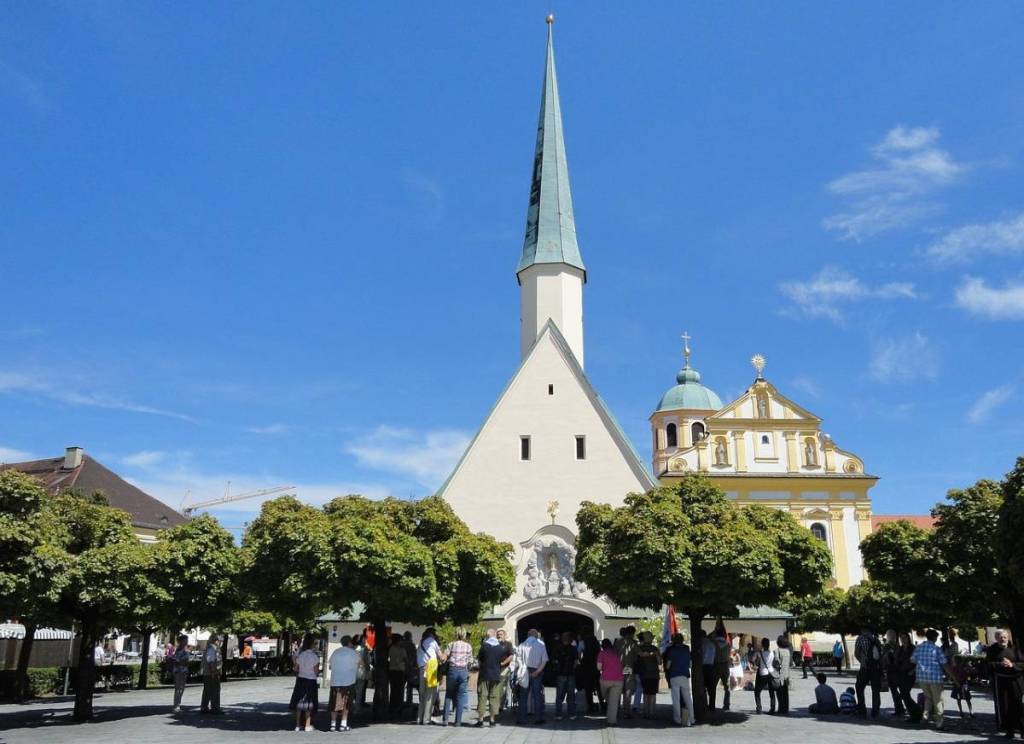

The Bavarian rulers and kings have left their mark to this day —and not just in Munich. In addition to castles and castle ruins, there are also numerous sites specifically dedicated to them, such as the Votive Chapel on Lake Starnberg or the new bust of “Kini” at the Cornelius Bridge. Another fascinating place where you can trace the history of the Wittelsbachs is the Gnadenkapelle in Altötting. This church, unassuming from the outside, surprises with its magnificent interior, worthy of a king’s tomb. For it is in this chapel that you’ll find the hearts of the Wittelsbachs.
A historic place of worship
We cannot say for certain exactly when the Chapel of Grace was built, but it was likely constructed between the 8th and 10th centuries. Since the 15th century, a legend has been associated with the building, transforming it into a pilgrimage church. A boy is said to have fallen into the Mönchbach stream and drowned. His mother then brought him to the church and laid him on the altar, where she prayed together with others for her child’s salvation and asked the Virgin Mary for help. And lo and behold, the boy opened his eyes and was alive again.
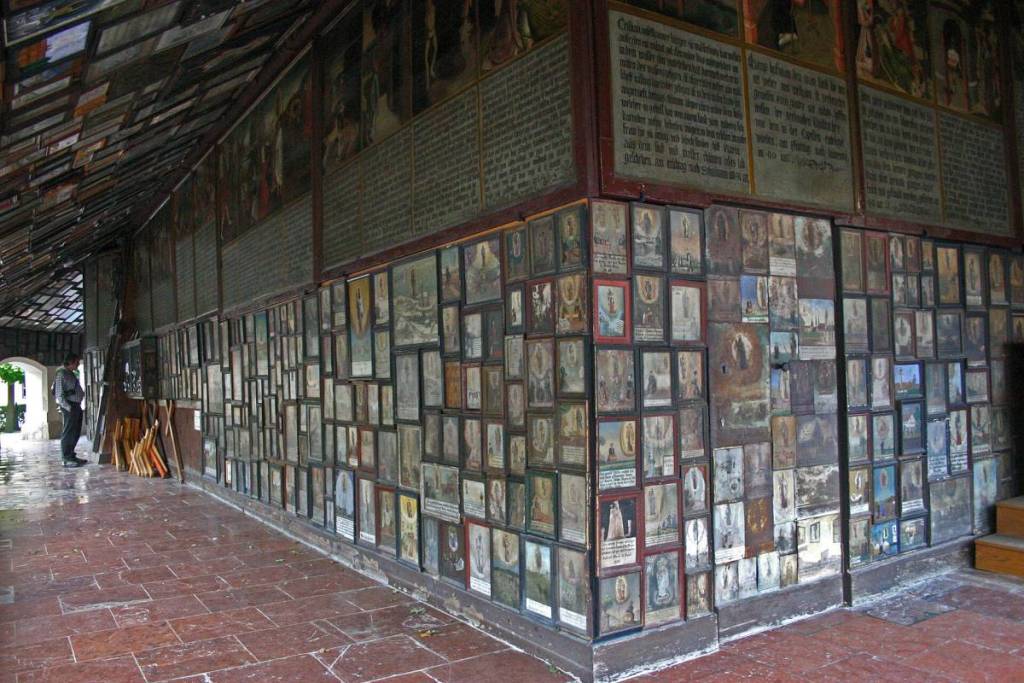
Following this miracle , the Chapel of Grace in Altötting became a destination for many pilgrims who sought the intercession of the miraculous image of the Madonna. They brought with them the images and relics they had collected, so that over time more than 2,000 votive images accumulated—which you can now view as you walk along the outer wall. There are so many images that they even extend all the way up to the ceiling of the portico. As you walk along here, you’ll feel more like you’re in a museum than in a church.
But the most valuable relic is undoubtedly found inside the chapel: the Black Madonna herself . This is a carved figure of the Virgin Mary, whose face and hands are black. She stands 64 centimeters tall and wears a crown and holds a scepter. These were given by Elector Maximilian I. Every year on Good Friday, the Madonna is veiled in a black veil, which is not removed until Easter.
The Gnadenkapelle in Altötting: A Resting Place for Hearts
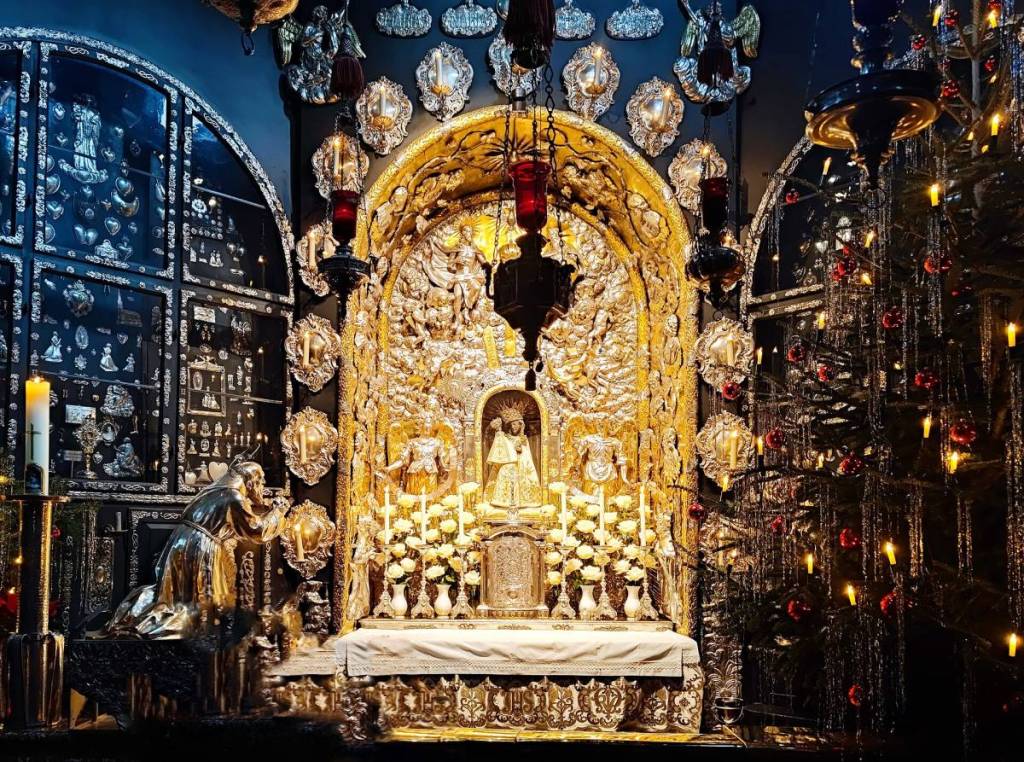
The soul resides in the heart—or so people used to believe. To ensure that the soul would reach heaven unharmed, members of the upper classes in modern times, in particular, had their hearts buried separately from their bodies. The Wittelsbachs were no exception: they sought to pass through the gates of heaven with the help of the Virgin Mary’s grace. So their hearts were placed in urns and interred in the Chapel of Grace in Altötting, while their bodies rest in Munich. Even today, you can visit their coffins in the crypts of St. Michael’s, the Frauenkirche, and the Theatinerkirche.
Most of their hearts, however, can still be found in Altötting. The church houses 27 heart urns containing 28 hearts, 14 of which are on display. Among them are Kings Max I and II, Ludwig I, II, and III, as well as Queen Maria Theresa. Emperor Charles VII shares an urn with his wife, for he believed, as the pedestal reveals: “Love is stronger than death.” Whether you’re a person of faith or simply interested in history, the Altötting Chapel of Grace is definitely worth a visit. The interior of the church is magnificently furnished and decorated, so there’s plenty more to discover besides the miraculous image and the urns.